

What Avalanche Summit 2026 Revealed About the Next Phase of On-Chain Finance
The most important thing I heard at Avalanche Summit was not a token price call or a throughput boast. It was an operating model question: if securities, cash and collateral all become programmable, what happens to the market around them?
That question marks a real change in tone. The industry no longer needs to prove that an asset can be represented on a blockchain. It needs to prove that the surrounding system can deliver liquidity, controls, interoperability, distribution and economic durability at institutional scale. Across sessions on market infrastructure, ETFs, regulation and Avalanche’s own economics, the same conclusion kept surfacing: on-chain finance is moving from an asset story to a systems story.
Four takeaways stood out: the operating model matters more than issuance; liquidity must precede product proliferation; familiar wrappers will coexist with crypto-native products; and both regulation and protocol economics now sit inside the institutional diligence perimeter.
The asset is not the system
Sandy Kaul of Franklin Templeton framed the transition as four linked shifts: regional trading sessions become continuous global markets; fragmented accounts become portable, controlled wallets; static fund wrappers become programmable software; and sequential hand-offs become near-atomic exchanges of assets and payment.
Each shift is individually familiar. Taken together, they imply something more consequential than faster settlement. Today’s market is a collection of proprietary books and records joined by point-to-point connections. Firms reconcile their own versions of the truth, run overnight batches and design controls around accounts that exist inside each institution. A shared transaction layer changes the coordination model: controls can attach to the wallet or asset, data can be available across participants in real time, and the same programmable standards can travel through the network.
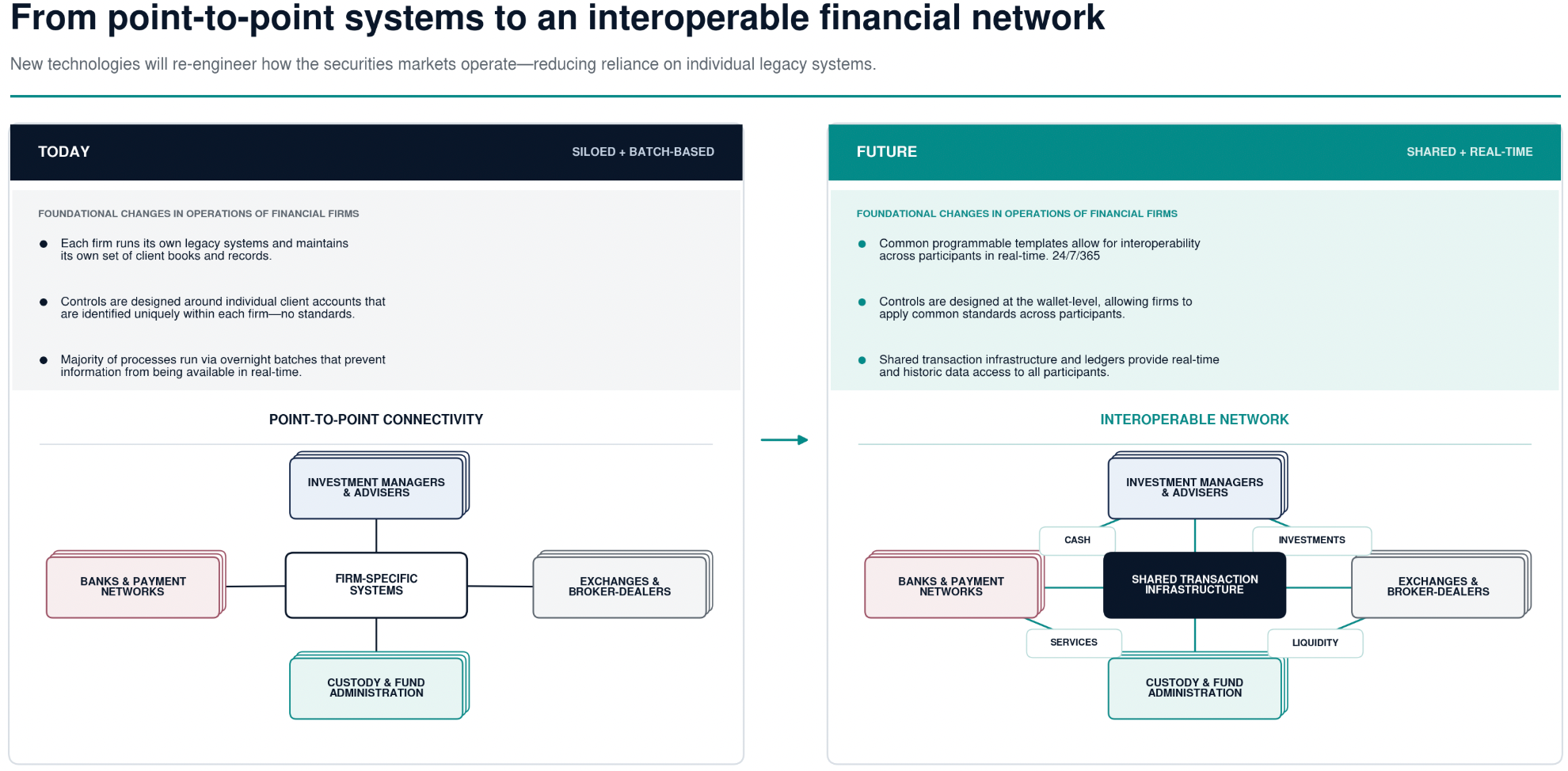
Adapted by Sender Consulting LLC from Avalanche Summit 2026.
That does not make banks, exchanges, asset managers, custodians or fund administrators disappear. It changes where coordination happens and what each intermediary must contribute. In a networked market, an institution’s advantage is less likely to come from owning a closed record and more likely to come from the quality of its risk controls, liquidity, distribution and services.
This is why tokenization should not be treated as a wrapper upgrade. The token may be the visible object, but the strategic change is underneath it: the market’s source of truth, its operating hours and the logic by which assets can move.
Liquidity comes before products
Kaul’s most useful sequencing point was simple: cash and collateral have to move reliably on the new rails before a broad product layer can scale. Blockchains and wallets provide storage; oracles, protocols and APIs provide connectivity; but stablecoins, tokenized deposits, central bank money and tokenized yield products are what turn that architecture into a financial market. Products sit on top of liquidity—not the other way around.
The public evidence is starting to support that view. Broadridge reported roughly $8 trillion of monthly volume on its Distributed Ledger Repo platform this year. DTCC describes its Collateral AppChain as moving from proof toward production infrastructure, with the goal of supporting multiple assets and networks and enabling 24/7 collateral mobility. Tokenized Treasury funds, meanwhile, totaled about $15.6 billion in distributed value as of September 16, according to RWA.xyz. These are different measures and stages of maturity, but they point in the same direction: the earliest scaled use cases are about moving cash-like assets and collateral more efficiently.
Franklin’s own blockchain-integrated recordkeeping is a helpful reminder not to confuse progress with purity. The structure has advanced far enough for SEC staff to grant no-action relief related to self-custody, yet the fund’s official ownership record still combines an internal book-entry system with public blockchains. That is not a contradiction. It is transition architecture: new rails being fitted into the legal and operational systems that already govern investor rights.
The strategic implication is that the most valuable layer may not be the issuer with the longest list of tokenized assets. It may be the system that can make multiple forms of money and collateral portable across venues, networks and regulatory perimeters without fragmenting liquidity or weakening controls.
Familiar wrappers are not a detour
The ETF discussion supplied a useful counterweight to the idea that everything will migrate directly into a wallet. ETFs remain effective because they package unfamiliar exposure inside familiar custody, brokerage, reporting and fiduciary processes. Those advantages do not evaporate simply because the underlying market becomes more programmable.
Panelists broadly expected on-chain products to grow faster while off-chain wrappers remain larger for years. That is not a failure of crypto-native finance. It is how financial distribution works: different investors need different interfaces, even when those interfaces increasingly reach the same underlying pools of assets and liquidity.
The real adoption milestone arrives when users no longer need to know—or care—that the infrastructure is on-chain. At the same time, the new rails should eventually produce forms that cannot be replicated cleanly in a conventional wrapper: automated token portfolios, direct ownership with composability, real-time financing and structured exposures assembled from programmable building blocks.
The near-term market therefore looks less like a contest between ETFs and wallets than a convergence. Familiar products provide distribution; crypto-native infrastructure changes what can be owned, financed and automated beneath the interface.
Regulation sets the tempo, not the destination
The regulatory panel met immediately after the CLARITY Act failed to clear a procedural hurdle in the Senate. The timing could have invited a binary conclusion: legislation failed, so market development stops. The panel’s more credible message was that institutional work continues, but the route becomes slower, more expensive and more dependent on agency action.
In the absence of a statute, no-action letters, interpretive guidance and rulemaking carry more weight. Their durability is not equal. A full notice-and-comment process can create a more stable foundation than a staff statement that a future administration may reverse. What institutions need is not perfect certainty; it is enough predictability to commit capital, build controls and explain the risk to boards and clients.
That distinction matters competitively. Large incumbents can amortize legal analysis and run parallel workstreams while policy evolves. Smaller firms face the same ambiguity with fewer resources. Regulatory delay therefore does more than slow an industry: it can shape who is able to participate.
Market structure questions are now squarely inside the mainstream policy agenda. The SEC’s September 17 roundtable on 24-hour trading, for example, addressed the operational and investor protection issues that arise when markets move beyond traditional sessions. The question is no longer whether technology permits continuous trading. It is how rules, surveillance, liquidity and safeguards should adapt.
The chain needs an income statement
The most interesting session focused on Avalanche’s own economics. Its premise was important: a network can process more activity while collecting less revenue per transaction. If validators are funded primarily through token issuance, higher usage does not automatically produce a self-sustaining security budget.
The proposed framework—Measure, Capture, Distribute—treats a blockchain less like a technology product with one fee line and more like an economy with multiple forms of output and income. Gross Chain Product measures what the network produces. Gross Chain Income asks where the associated income flows, including yield generated by stablecoin and real-world-asset reserves. The distinction matters because activity can create value that never accrues to the network or its participants.
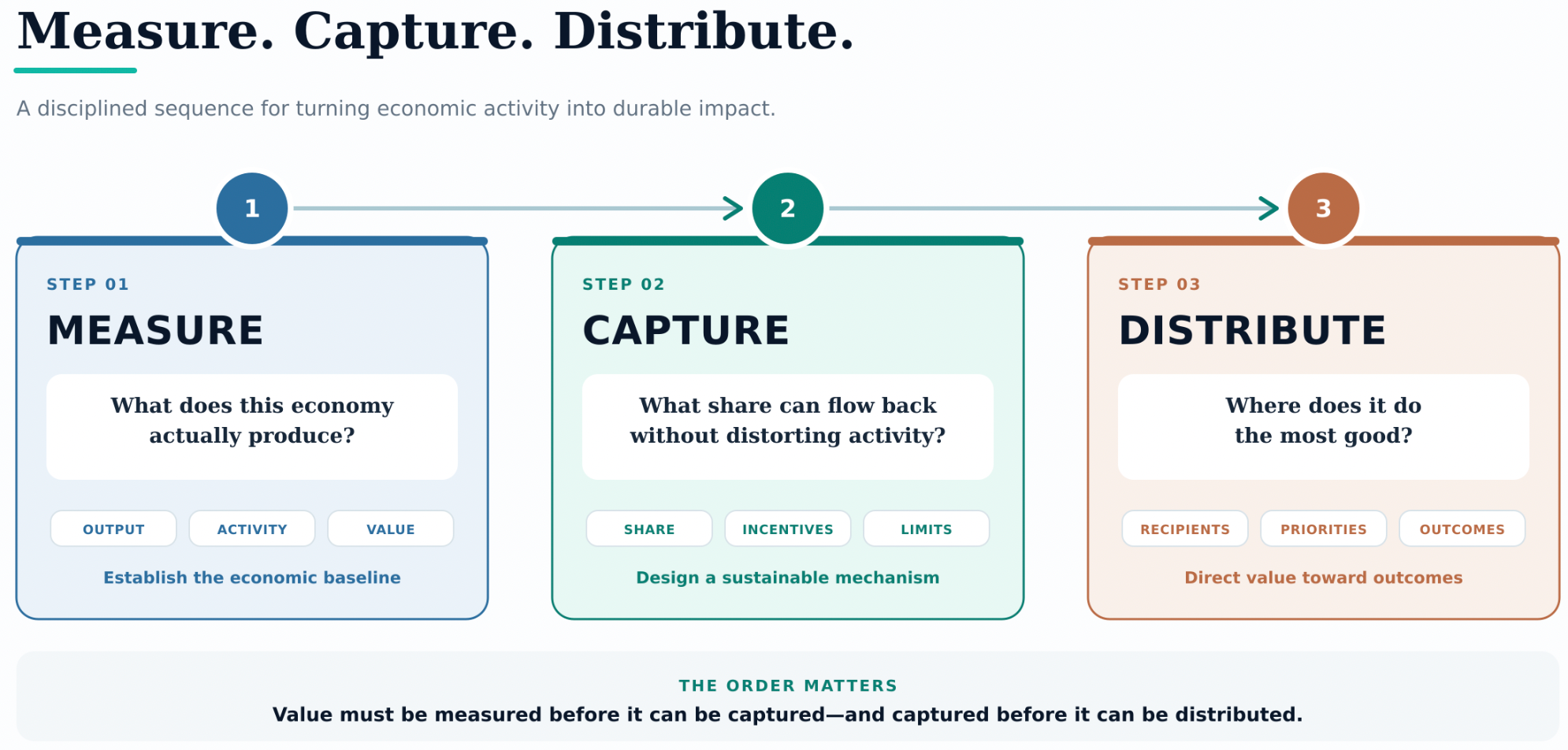
Adapted by Sender Consulting LLC from Avalanche Summit 2026.
Avalanche’s Helicon upgrade, scheduled for September 22, makes this more than an abstract accounting exercise. The package includes shorter minimum validator commitments, a redesigned staking reward curve and a validator-voted dynamic gas floor. Whatever one thinks of the individual parameters, the broader direction is clear: tokenomics is becoming an engineered operating model rather than a fixed emissions schedule.
For institutions, that belongs in infrastructure diligence. A chain that cannot sustain its validator set, security budget and service quality without indefinite dilution carries a continuity risk. The relevant question is not only whether the network is fast or inexpensive today. It is whether its economics can support the reliability an institutional market will require tomorrow.
What I’m taking into next week
Avalanche Summit made the next phase of on-chain finance look both more credible and more demanding. The technology is moving into production, but production changes the standard of proof. A tokenized asset is no longer enough. The surrounding system must provide portable liquidity, familiar distribution, durable rules and sustainable network economics.
That reframes the competitive landscape. Product announcements matter less than the ability to coordinate participants. Familiar wrappers are not evidence that the transition failed; they are part of the distribution bridge. Regulation is not a binary gate, but it does set the cost and tempo of execution. And protocol economics is not merely a debate for token holders; it is a question of infrastructure resilience.
The next phase will not be won by the chain with the most assets issued. It will be won by the systems that make liquidity portable, products familiar, rules durable and the underlying economics sustainable. At that point, the rails are no longer behind the market. They are the market.

Enjoyed this analysis?
Research boundaries
Research cutoff: September 2026. Legislative, regulatory, market, and protocol developments are described only as they stood at that cutoff.
Conference record: The analysis draws on the Avalanche Summit 2026.
Attribution: Speaker arguments, forecasts, and slide concepts are presented as attributed conference views—not independently established facts or industry consensus.
Evidence status: The research distinguishes among live transaction volume, point-in-time market data, infrastructure moving toward production, enacted regulatory guidance, pending legislation, and scheduled protocol changes.
Company-reported information: Broadridge transaction volume and DTCC production-readiness statements are issuer-reported and were not independently audited for this article.
Forward-looking information: The Helicon upgrade was scheduled for September 22, 2026 and had not activated by the research cutoff. Forecasts and proposed changes are not described as completed outcomes.
Regulatory limitation: The CLARITY Act reference reflects the September 15 procedural vote, not a final legislative disposition. The Franklin Templeton no-action relief is fact-specific and does not establish a generally applicable rule.
Analytical scope: The article evaluates market infrastructure, liquidity, distribution, regulation, and network economics. It is not a token-price forecast, comparative blockchain ranking, technical security audit, legal opinion, or investment recommendation.
Editorial interpretation: Conclusions about the competitive importance of liquidity, interoperability, distribution, and sustainable protocol economics are the author’s analysis of the cited evidence.
Sources
Broadridge Financial Solutions, Inc. Broadridge’s Distributed Ledger Repo Achieves 268% Year Over Year Growth in April. May 4, 2026. Company-reported average daily volume of $368 billion and nearly $8 trillion in April transaction volume.
The Depository Trust & Clearing Corporation. The DTCC Collateral AppChain: From Experiment to Production Infrastructure. May 15, 2026. Supports the discussion of multichain interoperability, collateral mobility, and the platform’s progression toward production infrastructure.
RWA.xyz. Tokenized U.S. Treasury Funds. Dashboard snapshot dated September 16, 2026. Source for the approximately $15.6 billion distributed-value figure used in the article.
Faegre Drinker Biddle & Reath LLP. SEC Staff Issues No-Action Letter Permitting Franklin Templeton Funds’ “Self-Custody” of Shares in Affiliated Money Market Fund with Blockchain-Integrated Recordkeeping. August 19, 2026. Analysis of the fact-specific relief, integrated book-entry and blockchain record, and associated operational safeguards.
Reuters. US Senate Fails to Advance Sweeping Cryptocurrency Bill in Blow for Industry. September 15, 2026. Supports the article’s description of the CLARITY Act’s failure to clear a Senate procedural hurdle.
U.S. Securities and Exchange Commission. Roundtable on Preparations for 24-Hour Trading. September 17, 2026. Official agenda addressing liquidity, surveillance, operational resilience, clearing, settlement, and investor protection in extended-hours markets.
Avalanche Developers. Helicon: Improved Staking Economics and Continuous Execution. September 8, 2026. Primary description of the upgrade scheduled for September 22, 2026, including shorter staking commitments, auto-renewed staking, a dynamic minimum gas price, and changes to the reward curve.
Board of Governors of the Federal Reserve System. Capital Treatment of Tokenized Securities Frequently Asked Questions. Last updated March 5, 2026. Clarifies that tokenization technology does not, by itself, alter the regulatory-capital treatment of an otherwise eligible security.