

Beyond the Country List: How to Decide Whether to Expand, Where to Go and How Much to Commit
“We should expand internationally” sounds like a strategy. It is usually only a direction.
The familiar market entry questions come later: Do customers speak the same language? How difficult is the regulatory environment? Should the company enter through a distributor, a joint venture, an acquisition or a new local operation?
Those questions matter. But they can create a false sense of rigor if leadership has not answered the more basic ones: What problem is geographic expansion meant to solve? Why should this company win outside its home market? Which sources of advantage will travel, which will weaken at the border and what evidence would justify putting more capital at risk?
I learned to see the gap while working in expatriate tax. A decision that appeared on a strategy slide as “send a leader into the market” became, in practice, a web of immigration, payroll, tax residency, permanent establishment exposure, social security, benefits, equity compensation and family considerations. The employee did not simply cross a border. The company’s operating model crossed with them.
That experience left me with a broader conclusion: international expansion does not fail only because executives choose the wrong country. It can fail because a country is treated as a market, market attractiveness is confused with company fit, and the entry vehicle is selected before the uncertainties are understood.
The better question is not, “Which country should we enter?” It is, “Where can our advantage create value after the full cost of distance is paid?”
First decide what expansion is for
International expansion can create value in several distinct ways. It can follow existing customers, reach new demand, access scarce talent or capabilities, secure supply, improve proximity to production, acquire strategic assets, or reduce dependence on one revenue or operating base. These are not interchangeable rationales. Each implies a different market, entry model, investment case and definition of success.
A company following multinational customers may value consistency, service coverage and retention more than the stand-alone profitability of the new geography. A company seeking growth should care about addressable demand, willingness to pay and its ability to acquire customers. A company seeking talent may never need a local sales organization. A company building supply chain resilience may rationally accept higher unit cost in exchange for continuity and optionality.
The first discipline, then, is to state the strategic job in one sentence:
We are considering expansion into [market] to [solve a specific strategic constraint or capture a defined opportunity], using [a transferable advantage], and we will know the thesis is working when [observable milestones] occur by [date].
If leadership cannot complete that sentence without relying on “large market,” “high growth” or “our competitors are there,” the expansion thesis is not yet ready.
Growth is not automatically evidence of fit. Competitor presence is not proof of competitor profitability. Diversification does not reduce risk when every new geography depends on the same supplier, technology, funding source or customer segment. Sometimes international expansion is the right growth path. Sometimes the higher return decision is deeper penetration, a new customer segment, a product extension or a partnership that creates reach without geographic infrastructure.
Geography should have to win the capital allocation argument.
The market is not the country
Country rankings are useful for building a longlist. They are weak substitutes for a commercial thesis.
A “market” is better defined as a specific combination of customer, problem, offer, channel and operating model within a geography. The same country can contain an attractive enterprise segment and an unattractive consumer segment; an accessible digital channel and a closed physical channel; a permissive regime for one service and a restricted one for another.
This distinction matters because national averages hide the point at which the company will actually compete. GDP growth does not reveal whether target buyers can switch suppliers. Population does not reveal whether the company can reach those buyers economically. Ease of doing business does not reveal whether a sector requires local licenses, data localization, domestic ownership or regulated distribution.
Public datasets can make the first screen more rigorous. The World Bank’s Business Ready framework separates the quality of regulation from public services and the efficiency experienced by firms. The OECD’s Services Trade Restrictiveness Index tracks sector-specific barriers including restrictions on foreign entry, movement of people and regulatory transparency. The World Bank Enterprise Surveys add evidence about how businesses actually experience infrastructure, finance, labor, taxation and informality. The ESCAP–World Bank Trade Cost Database helps expose bilateral frictions that market size statistics omit.
These tools help identify where to investigate. They do not make the decision. A company still needs primary evidence from the customers, channels, regulators, employees and partners that determine its own economics.
Test whether the advantage survives the border
The most important market selection question is not how attractive the country is in isolation. It is whether the company has a right to win there.
Start with the source of success at home. Is it the product, brand, intellectual property, cost position, customer data, distribution network, regulatory credibility, supplier relationships, service model or the tacit judgment of experienced employees? Then test how much of that advantage transfers.
Some advantages travel easily. Software code can be replicated at low marginal cost, although the commercial and regulatory model around it may not. A patented product can cross a border, but its reimbursement or distribution model may not. A trusted brand can carry recognition, or it can arrive with no meaning at all. A service business may appear asset-light until success depends on local relationships and judgment that took years to develop at home.
This is the practical meaning of the “liability of foreignness” documented in international business research: foreign firms may bear additional costs because they lack local knowledge, networks, legitimacy or familiarity with institutions. Distance is not merely mileage. Cultural, administrative, geographic and economic differences affect different industries in different ways.
A useful transferability audit asks four questions:
What must remain standardized? Identify the elements that create the company’s advantage and cannot be localized without weakening the proposition.
What must be adapted? Test changes required in product, pricing, language, contracting, service, payment, data, brand and customer support.
What must be acquired locally? Identify licenses, relationships, talent, physical assets, distribution access and political or institutional knowledge the company does not possess.
What becomes less valuable abroad? Name the advantages that depend on home market scale, regulation, brand recognition, customer density or shared infrastructure.
The goal is not to eliminate localization. It is to determine whether the value created by entering the market exceeds both the visible cost of adaptation and the loss of advantage that adaptation can cause.
Replace the country ranking with a decision stack
Market attractiveness should not be reduced to one weighted score. A high total can conceal a fatal flaw: prohibited ownership, unattainable licensing, no viable route to the customer, structurally poor margins or risk that the board would never accept.
Use gates first, then compare the markets that survive them.
Gate 1: Strategic relevance
Does the market directly serve the stated purpose of expansion? Would entering it strengthen the core business, or create a disconnected second business that happens to share a brand?
Gate 2: Transferable advantage
Can the company name the capability that will cause customers to choose it? Is that advantage scarce locally, defensible and meaningful after adaptation?
Gate 3: Lawful, practical access
Can the company sell, deliver, hire, contract, move data, receive payment and repatriate cash through a feasible structure? “Technically permitted” is not the same as operationally workable.
Gate 4: Credible economics
Can the opportunity clear the company’s return threshold after localization, compliance, tax, working capital, channel margin, foreign exchange, duplicate overhead and exit costs—not merely after product and sales expense?
Gate 5: Acceptable downside
Can the company limit its initial commitment, learn before scaling and exit without disproportionate financial, legal, reputational or employee harm?
Markets that pass the gates can then be compared across six dimensions:
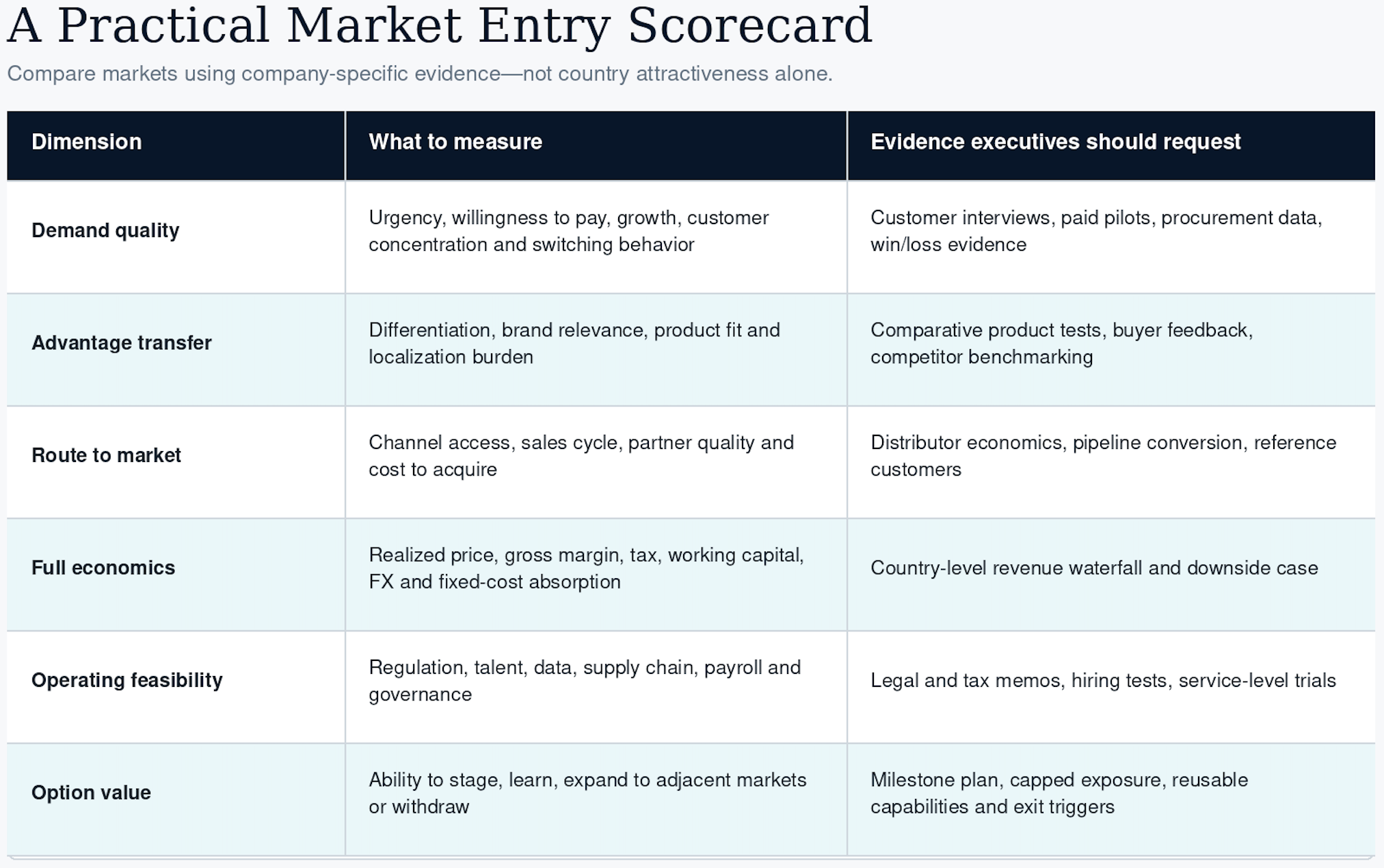
Analysis by Sender Consulting LLC.
Weighting still has a role, but the weights should follow the strategic purpose. A demand-seeking expansion should not use the same scorecard as a resilience investment or talent hub. Sensitivity analysis matters more than the precise score: if a small change in assumptions produces a different “winner,” leadership has learned that the ranking is fragile and more evidence is needed.
Build the economics from the customer backward
Many expansion cases begin with total addressable market and work downward only far enough to produce an encouraging revenue number. A better model begins with the customer the company can actually reach.
Translate the headline market into a revenue waterfall:
Total demand → relevant segment → reachable accounts → qualified opportunities → expected wins → realized price → retention and expansion
Each arrow is an assumption to be tested. The company should know how customers buy, who controls the budget, how long procurement takes, what incumbent must be displaced, whether references must be local and how much pricing survives channel discounts, tax and currency effects.
Then construct the cost stack that rarely appears in the first presentation:
product and language localization;
regulatory approvals, ongoing compliance and local professional advice;
entity formation, governance, accounting and statutory reporting;
recruiting, compensation, benefits, payroll and employment obligations;
expatriate tax, immigration, shadow payroll, social insurance and mobility support;
distributors, agents, joint venture economics and partner oversight;
data hosting, cybersecurity, insurance and recordkeeping;
inventory, logistics, duties, returns and working capital;
foreign exchange volatility, trapped cash and financing cost;
management attention, duplicate infrastructure and exit obligations.
This is where the expatriate tax lens becomes strategic. A person in a market may create obligations before the company believes it has formally “entered.” Titles, travel patterns, authority to negotiate or conclude contracts, remote work and time spent in country can affect tax, payroll and immigration analysis. The exact consequences are jurisdiction-specific, but the management principle is universal: people deployment is part of market entry design, not an administrative task to address after the commercial decision.
The investment case should include a base case, a delayed-ramp case and a stop-loss case. The most useful question is often not, “What is the five-year NPV?” It is, “Which two assumptions account for most of the value, and what can we learn about them before making the investment irreversible?”
Choose the entry mode after locating the uncertainty
There is no universally superior entry method. The right structure depends on what the company must control, what it needs to learn and which assets are missing.
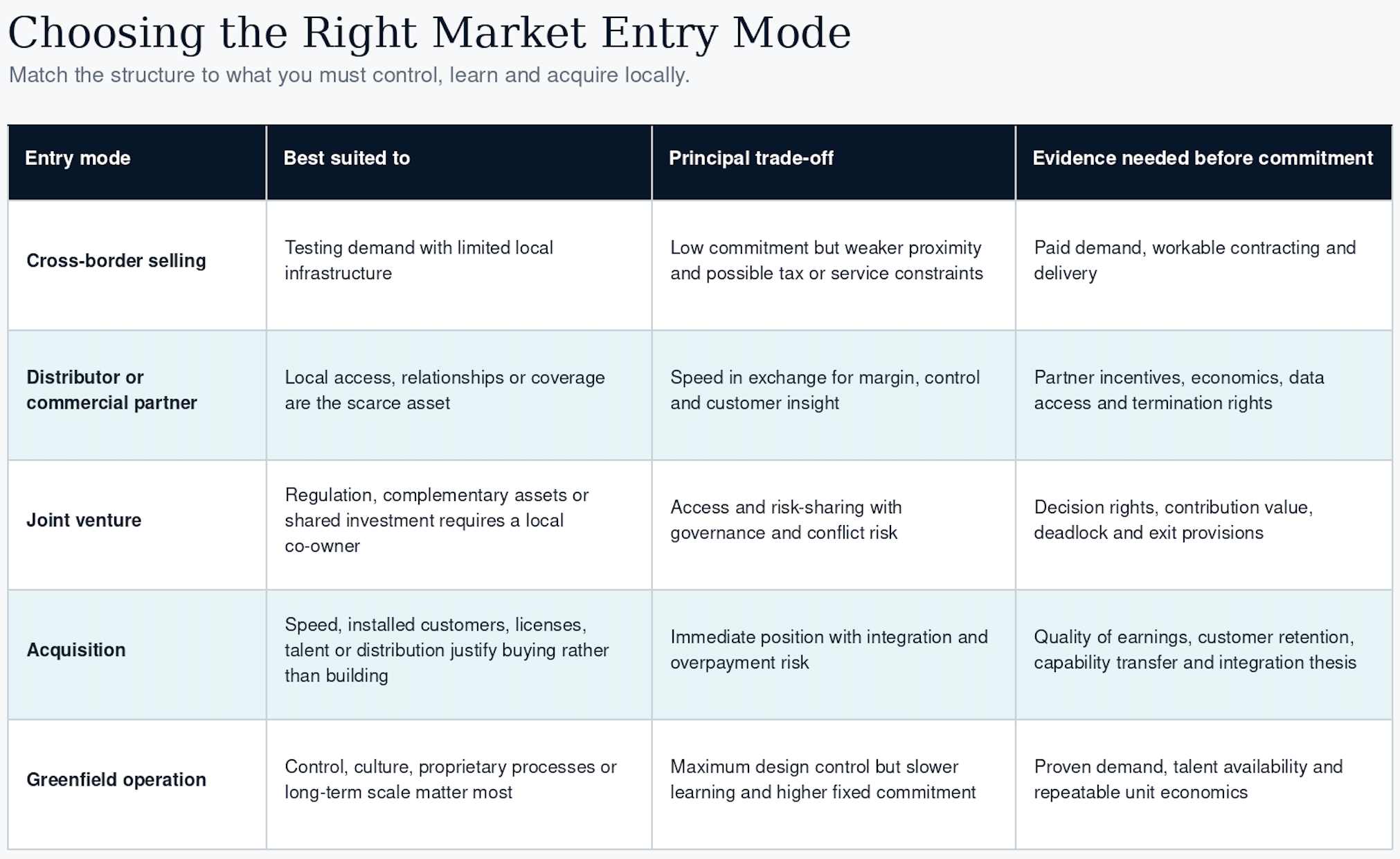
Analysis by Sender Consulting LLC.
The sequence matters. A company should not acquire merely because acquisition is fast, partner merely because the market is unfamiliar, or build merely because it prefers control. Entry mode should solve the binding constraint.
If uncertainty is primarily demand, begin with a commercial test. If it is distribution, test partners. If the market requires licenses or trusted relationships that take years to develop, acquisition may be rational. If the advantage depends on proprietary operations that a partner could not reproduce, greenfield investment may be worth the additional time.
Control also has more than one dimension. A partner may own the customer relationship while the company controls the product. A joint venture may provide legal access while slowing decisions. An acquisition may deliver formal control but leave the buyer dependent on the acquired management team. Executives should specify which rights matter: pricing, brand, data, customer ownership, hiring, capital expenditure, compliance, intellectual property and exit.
Buy evidence before buying scale
The purpose of an entry plan is not to predict the market perfectly. It is to arrange commitments so the company learns while downside remains limited.
A staged evidence ladder can move from:
public data and expert interviews;
direct customer and channel research;
localized proposition and pricing tests;
paid pilots or cross-border sales;
limited local presence or partnership;
entity formation and repeatable commercial proof;
scaled hiring, infrastructure or acquisition.
Every stage should have an explicit question, budget, deadline and decision rule. For example: Can ten target customers describe the problem without prompting? Will three pay for a pilot? Does realized pricing preserve the target contribution margin? Can a partner produce qualified pipeline while meeting data and compliance requirements? Can the business recruit the needed talent within the compensation case?
Milestones should measure evidence, not activity. Opening an office, signing a memorandum of understanding and hiring a country manager are actions. They do not prove demand. A better dashboard tracks paid conversion, sales cycle length, gross margin realization, renewal, implementation cost, service quality, regulatory progress and the proportion of results dependent on headquarters intervention.
The company also needs exit triggers before enthusiasm and sunk cost take hold. If licensing exceeds a defined date, customer acquisition cost remains above a threshold, the partner withholds customer data, or local economics require permanent subsidy, leadership should know whether to adapt, pause or leave.
What leadership should be able to say
Before approving entry, an executive team should be able to explain the decision without using the size of the country as the central argument.
It should be able to say:
why geographic expansion beats the other uses of capital;
which specific customer and problem define the market;
what advantage will travel and what must be rebuilt locally;
which assumptions drive the economics;
which risks are fatal, which are manageable and which are being accepted deliberately;
why the entry mode fits the missing assets and uncertainties;
what the company will prove before the next commitment; and
what evidence would cause it to stop.
The objective is not to remove uncertainty. International growth will always require judgment under incomplete information. The objective is to stop paying for uncertainty that could have been resolved earlier and more cheaply.
A country is not a strategy. It is a collection of customers, institutions, channels, obligations and operating realities. The strategic decision is whether a company’s advantage can create value inside that system—and how to learn the answer before the commitment becomes difficult to reverse.

Enjoyed this analysis?
Research boundaries
Purpose and scope. This article provides a strategic framework for deciding whether, where and how to enter a new geographic market. It does not recommend entry into any particular country, sector or transaction.
Strategic rather than predictive. The framework identifies questions, evidence and decision gates for market entry. It does not forecast market growth, revenue, profitability, customer conversion or investment returns.
Country data are screening tools. Business environment indicators, trade restriction measures and trade cost data can support an initial market screen. They do not establish company-specific demand, competitive advantage, regulatory eligibility or commercial viability.
The market is narrower than the country. National indicators may conceal material differences by customer segment, industry, product, channel, region and business model. A favorable national score should not be treated as proof that a particular opportunity is attractive.
No universal market weighting. The article does not prescribe fixed weights or scoring thresholds. The importance of demand, resilience, talent, regulation, cost, control and option value should follow the company’s stated reason for expanding.
Entry modes are analytical categories. Cross-border selling, commercial partnerships, joint ventures, acquisitions and greenfield operations are compared at a strategic level. Actual structures can combine these approaches and require company-, sector- and jurisdiction-specific diligence.
Primary evidence remains necessary. Public datasets and published research identify where to investigate. They do not replace customer interviews, pricing tests, paid pilots, partner diligence, regulatory advice, tax analysis or direct operating evidence.
Tax and employment outcomes are fact-specific. References to permanent establishment, payroll, immigration, social insurance, employee mobility and related obligations illustrate potential operating consequences. Actual treatment depends on domestic law, applicable treaties, employee activities, authority, duration and other facts.
Foundational research remains conceptually relevant. The liability-of-foreignness and CAGE frameworks date from 1995 and 2001, respectively. They are included for their enduring analytical concepts, while current institutional resources support the article’s discussion of operating conditions and cross-border barriers.
No legal, tax or investment advice. The article is intended for strategic planning. Companies should obtain qualified legal, tax, regulatory, employment and financial advice before entering or operating in another jurisdiction.
Sources
World Bank Group. “Business Ready 2025.” 2025. The B-READY framework evaluates business environments through three pillars: regulatory framework, public services and operational efficiency. The methodology was used to support the distinction between formal rules and the conditions firms experience in practice.
World Bank Group. “Enterprise Surveys.” Current database and methodology. The surveys collect firm-level evidence from business owners and senior managers across more than 160 economies, covering areas including finance, infrastructure, labor, taxation, corruption, competition and business performance.
Organisation for Economic Co-operation and Development. “Services Trade Restrictiveness Index.” Current indicators and regulatory database. The STRI was used to support the article’s discussion of sector-specific barriers involving foreign entry, movement of people, competition and regulatory transparency.
United Nations Economic and Social Commission for Asia and the Pacific and World Bank. “ESCAP–World Bank Trade Cost Database.” Current database. The bilateral dataset was used to support the conclusion that geographic opportunity should be evaluated alongside the broader costs and frictions of trading across borders.
Organisation for Economic Co-operation and Development. “Model Tax Convention on Income and on Capital: Condensed Version 2017.” OECD Publishing, 2017. The convention provides the international reference framework underlying many bilateral tax treaties, including concepts relevant to permanent establishment and the allocation of taxing rights.
Zaheer, Srilata. “Overcoming the Liability of Foreignness.” Academy of Management Journal 38, no. 2, April 1995: 341–363. The article provides the foundational basis for the concept that foreign firms may incur additional costs because of distance, unfamiliarity, discrimination and weaker local networks or legitimacy.
Ghemawat, Pankaj. “Distance Still Matters: The Hard Reality of Global Expansion.” Harvard Business Review, September 2001. The article introduces the cultural, administrative, geographic and economic dimensions of distance used to explain why market size alone is an inadequate basis for international expansion.