

Private Markets ETFs Broaden Access but Adoption Remains Narrow
Issuers are broadening access to private markets exposure through ETFs. The funds remain small and concentrated, and early assets do not yet demonstrate broad retail adoption.
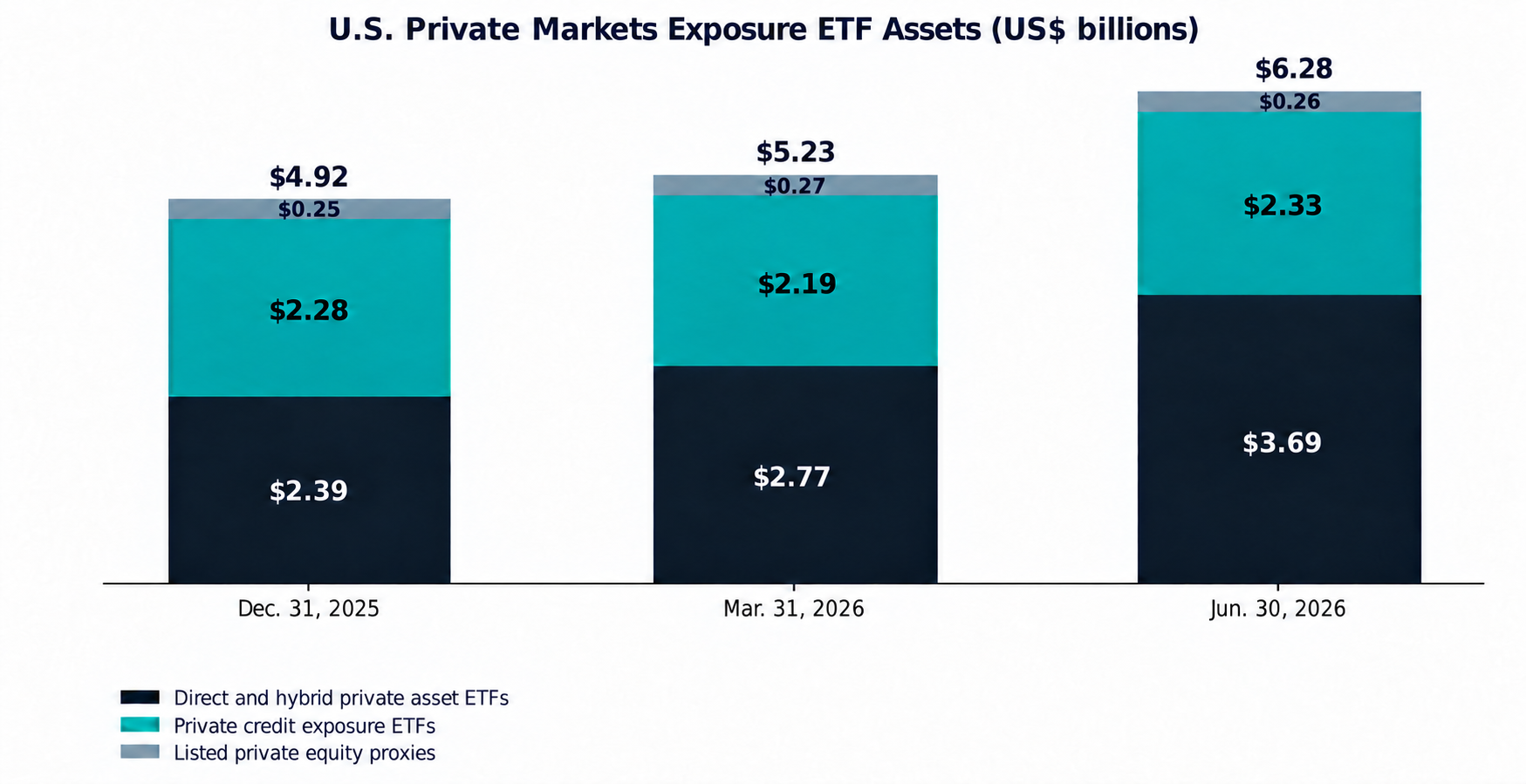
Sender Consulting LLC analysis. Universe and methodology appear in the Sources below.
Private markets ETFs remain an emerging distribution model: issuers seek broader access through direct, hybrid and proxy structures, but assets remain concentrated and genuinely private exposure varies widely.
A nascent market combines two different structures
Private markets were built around patience. ETFs were built around immediacy. Putting the two together sounds ingenious or contradictory, depending on whom you ask.
Since 2025, managers have introduced ETFs offering exposure to private companies, private credit and the public securities that finance them. Their stated proposition is to broaden access to markets historically dominated by institutions through a familiar vehicle that trades throughout the day.
The label, however, hides three different exposure models:

Sender Consulting LLC analysis.
A fund can therefore be marketed around private markets while holding only a controlled allocation to genuinely private assets. That is not necessarily a flaw. It is the mechanism that allows many of these products to operate inside a daily liquidity wrapper.
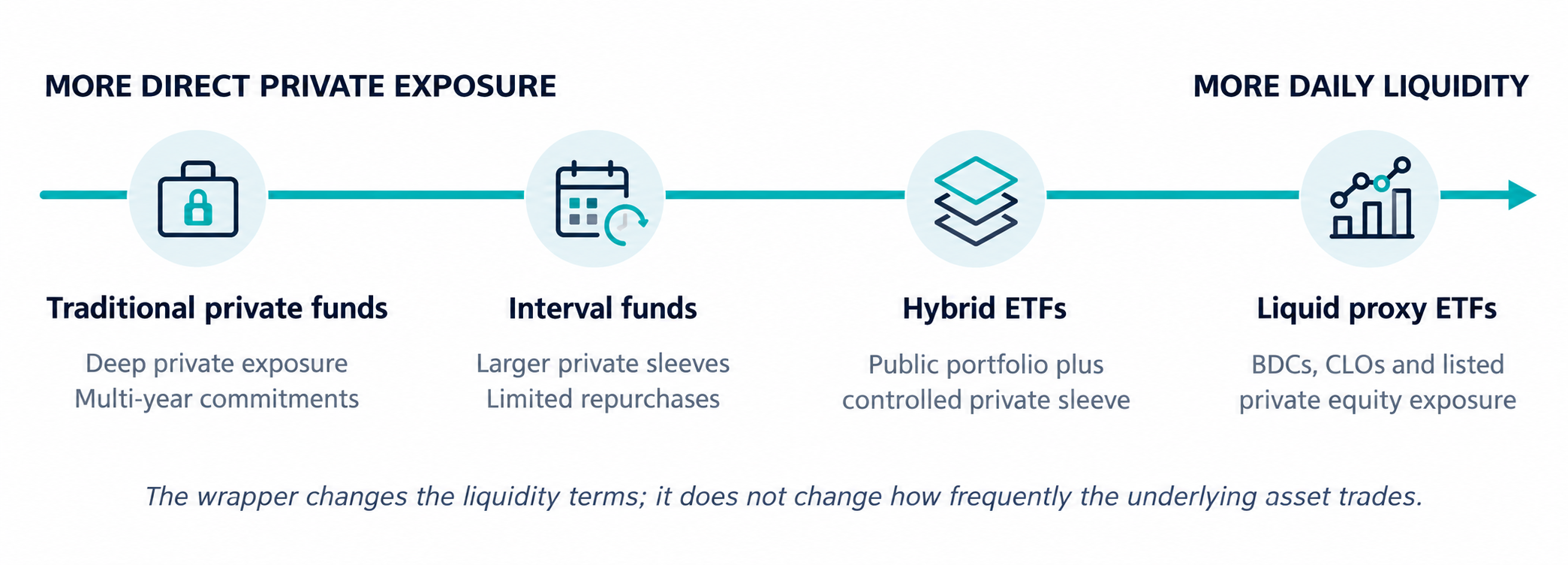
Sender Consulting LLC analysis.
Private exposure and investor liquidity generally move in opposite directions. The appropriate structure depends on which side of that trade-off the investor values more.
The measurable market is still small and difficult to classify
Our bottom-up review identified approximately $6.3 billion across 15 U.S.-listed private markets exposure ETFs as of June 30, 2026: $3.7 billion in direct or hybrid private asset ETFs, $2.3 billion in private credit exposure ETFs and $259 million in listed private equity proxies. At fund industry scale, this is a small market, and three products—XOVR, BIZD and PRIV—accounted for roughly three-quarters of the researched universe.
The total exceeds a simple “private equity” or “private debt” category screen because classification systems generally follow the dominant portfolio. XOVR can hold a private company and still sit in a conventional equity category; PRIV can hold Apollo-sourced private credit and still behave predominantly like a public bond portfolio. The taxonomy has not caught up with the product design.
What issuers say they are trying to accomplish
Sponsor statements and product materials consistently emphasize access, tradability and the convergence of public and private markets. The research supports four stated objectives:
Broaden access. State Street described PRIV as a way to democratize access to investment-grade private credit, and Apollo has separately emphasized expanding advisor and individual investor access to alternative investments.
Use a familiar wrapper. The ETF structure places the exposure in brokerage accounts and offers intraday trading without the capital calls and multiyear lockups associated with traditional private funds.
Combine specialist capabilities. Partnerships allow a private markets firm to contribute sourcing or origination while an established ETF sponsor provides portfolio management, distribution and operating infrastructure.
Advance public and private market convergence. Apollo and State Street have emphasized more frequent pricing, disclosure, identifiers, reference data and settlement as requirements for making private credit more broadly accessible and tradable.
State Street shows how the partnership model works
State Street’s private credit ETFs were not isolated product bets. They formed part of a broader partnership-led expansion into differentiated exposures. Galaxy supplied digital asset expertise; Apollo supplied private credit origination and access; State Street supplied the ETF management, distribution and operating platform.
When State Street launched PRIV in February 2025, it described the objective directly: democratize access to investment-grade private credit through an actively managed, liquid and tradable ETF. Apollo would source private investments, while the portfolio would also hold public investment-grade debt. State Street followed with PRSD in September 2025, adding a shorter-duration public and private credit strategy designed around income and reduced interest-rate sensitivity.
The division of responsibilities is visible in the product structure. Apollo sources private credit and provides executable bids on eligible assets. State Street manages and distributes the ETF, while State Street affiliates also provide administration, custody, transfer agency and other operating functions.
The strategic point is easy to miss: State Street did not merely win servicing mandates after the category developed. Through affiliated products such as PRIV and PRSD, it helped create part of the market that its organization now services.
What the evidence does not establish: The sources do not establish that private markets ETFs will become a large standalone category or that retail investors will adopt them broadly. They establish the issuers’ intention to widen access; observed assets and flows show that adoption remains limited and disproportionately institutional.
The first buyers complicate the democratization story
Products designed to widen access have initially derived much of their scale from institutions. By August 2026, one institution—the Texas Permanent School Fund—accounted for roughly $740 million of PRIV’s $834 million. XOVR received approximately $1.4 billion from institutional investors before ERShares restricted additional institutional purchases to preserve retail participation.
That does not mean retail demand will not develop. Active ETFs often need time to establish track records and gain placement on advisor and distribution platforms. It does mean that current assets cannot be treated as clean evidence of broad individual investor adoption. Some institutional demand may also reflect access to a particular pre-IPO holding or an expected liquidity event rather than a strategic private markets allocation.
The wrapper does not make the underlying asset liquid
An ETF share can trade every day even when an underlying loan does not. The portfolio, its authorized participants and any contractual liquidity arrangements must bridge that difference.
PRIV illustrates the compromise. It combines Apollo-sourced private investments with a larger public investment-grade credit allocation. Other ETFs use BDCs, CLOs or listed private equity firms instead of holding the underlying private loans or companies. Those designs can preserve tradability, but they may behave differently from a traditional private fund and may capture less of the illiquidity premium investors associate with private assets.
Morningstar has questioned whether hard-to-trade assets impair familiar ETF benefits. Less observable pricing can complicate portfolio valuation and the arbitrage mechanism, while higher fees and taxable distributions can weaken the cost and tax advantages investors expect from ETFs. Its 2026 research also emphasizes that ETFs generally hold smaller private sleeves than interval funds because the ETF must support daily trading.
Market commentary remains divided
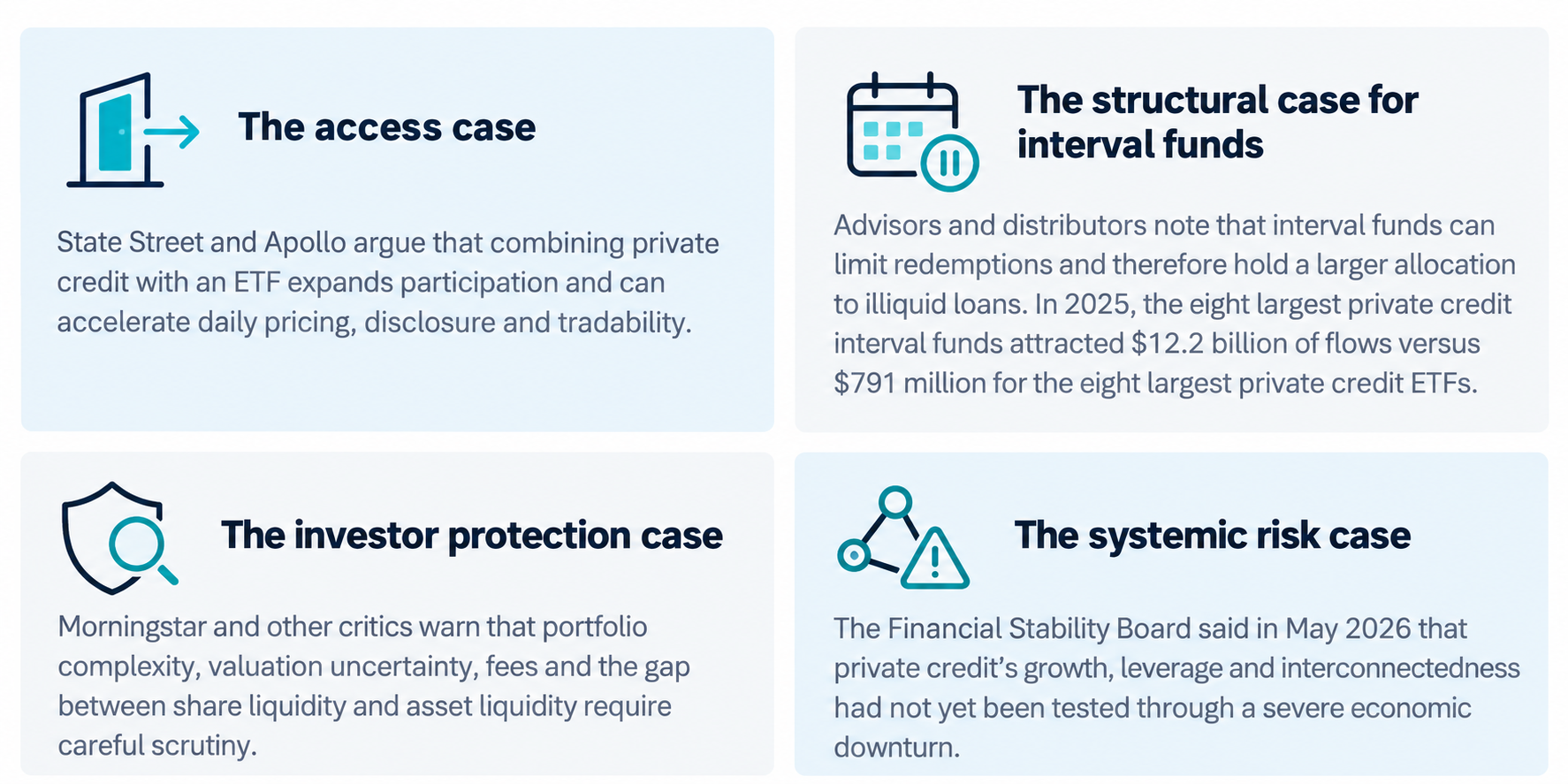
Sender Consulting LLC analysis.
The products also require operating infrastructure
Private assets historically relied on bespoke documentation, periodic valuation and limited secondary trading. A daily-traded product therefore requires pricing, data, liquidity oversight and settlement processes capable of supporting a more frequent operating cycle.
• Valuation: Daily net asset values require observable inputs, documented methodologies and escalation processes for securities without continuous market quotations.
• Liquidity oversight: Managers must classify and monitor portfolio liquidity, model stressed conditions and understand which holdings or counterparties can support redemptions.
• Reference data: Private instruments need consistent identifiers, terms and ownership records to move through systems designed for standardized public securities.
• Fund accounting: Public and private assets must be represented within one accounting, income accrual and financial reporting framework.
• ETF operations: Creation and redemption activity, basket construction and authorized participant interactions must work around holdings that may not transfer as readily as public securities.
Apollo’s 2026 commentary highlights the same direction of travel: broader private credit participation depends on daily pricing, common identifiers, standardized reference data, more efficient settlement and deeper secondary market participation. These are market development requirements, not evidence that every servicer already differentiates on them.
For asset servicers, the immediate opportunity is therefore concrete but measured. The products create mandates for custody, administration, fund accounting and transfer agency. If direct private holdings grow, valuation support, liquidity data and private asset operations become increasingly important. The research supports describing these as required capabilities—not yet as a proven basis of competitive advantage across the industry.
What the evidence supports next
Current evidence favors coexistence rather than replacement. Traditional funds maximize private exposure but require long commitments. Interval funds accept limited liquidity to hold more illiquid assets. ETFs maximize access and tradability but generally must limit, combine or transform the private exposure.
Whether ETFs earn a larger role will depend on evidence that is not yet available: broader retail and advisor adoption, performance through stressed markets, reliable valuation and liquidity, and continued distribution-platform acceptance.
Issuers are using ETFs to widen access to private markets exposure, but the current evidence does not yet show broad adoption. The decisive evidence will come from whether ownership expands beyond a small number of institutions and how these products behave when markets become less accommodating.

Enjoyed this analysis?
Research boundaries
Research period: Findings reflect information available through October 13, 2026. External market commentary and issuer materials were limited to sources published from 2025 onward unless earlier information was necessary to establish product structure or launch history.
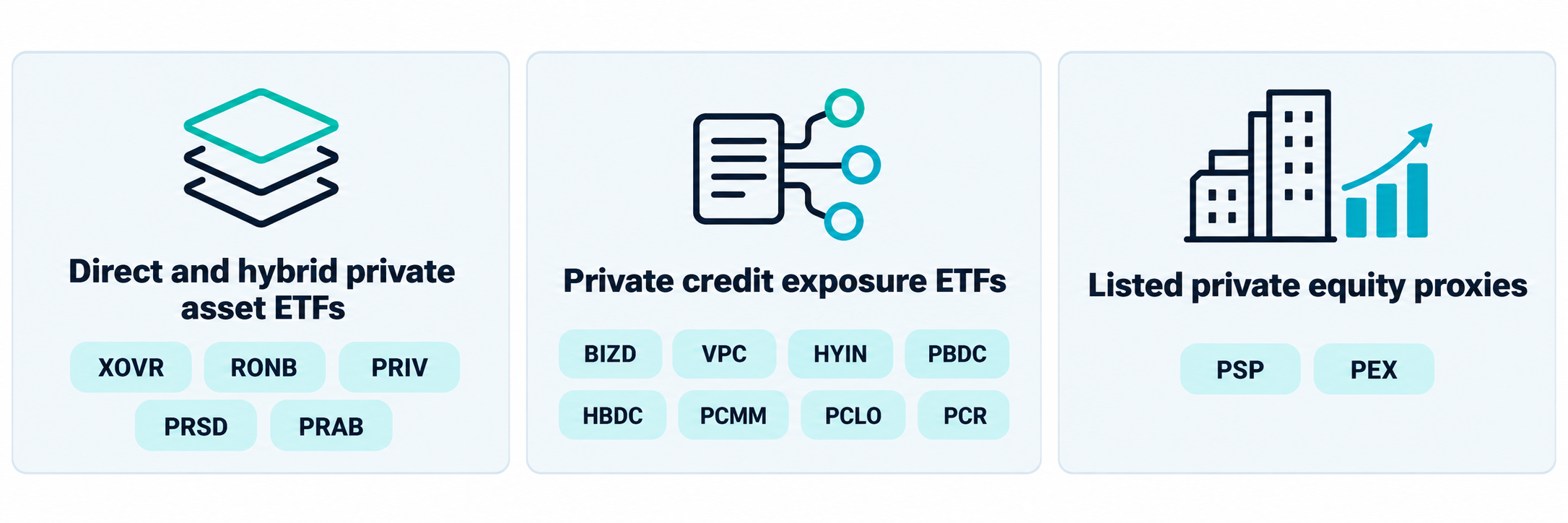
Defined universe: Market size analysis covers 15 U.S.-listed ETFs selected because they provide direct, hybrid or publicly traded proxy exposure to private markets:
Research-defined, not industry-defined: The universe is an analytical grouping, not a formal regulatory category. Classification systems generally categorize funds according to their dominant portfolio exposure and may place these ETFs in conventional equity or fixed-income categories.
Exposure is not equivalent across funds: Some included ETFs hold private securities or loans directly, others combine a limited private allocation with public assets, and others invest exclusively in publicly traded BDCs, CLOs or private capital managers.
Proxy funds are not direct private investments: BDC, CLO and listed private equity ETFs provide economic exposure to private markets but do not necessarily give investors ownership of the underlying private companies or loans.
Market-size methodology: The $6.3 billion estimate represents aggregate assets under management across the defined universe as of June 30, 2026. Historical totals are point-in-time asset values and reflect both investor flows and market performance.
Short measurement period: The analysis covers December 31, 2025 through June 30, 2026. The period is sufficient to show recent direction but not to establish a long-term growth rate or durable adoption trend.
Concentration matters: Aggregate assets are heavily influenced by a small number of funds. XOVR, BIZD and PRIV represented roughly three-quarters of the defined universe as of June 30, 2026.
Issuer objectives versus market outcomes: Statements concerning broader access, liquidity, tradability and public-private market convergence reflect issuer-stated objectives. They should not be treated as proof of broad retail adoption or evidence that the products were deliberately launched as tests of investor demand.
Investor adoption remains difficult to isolate: Publicly available asset and flow data generally do not provide a complete breakdown by retail, advisor and institutional ownership. Conclusions about investor concentration are limited to specific holdings and flows disclosed in the cited research.
Servicing analysis is based on visible assignments: Custody, administration, transfer agency and related servicing relationships were identified from public filings and product disclosures. The research does not establish that these mandates represent the entire servicing arrangement or prove a broader competitive advantage.
No performance recommendation: The analysis evaluates market structure, product design and servicing implications. It does not assess investment suitability or constitute a recommendation to purchase any included ETF.
Sources
• State Street Investment Management. PRIV launch and stated purpose, February 27, 2025
• State Street Investment Management. PRSD launch and public and private credit convergence, September 10, 2025
• Reuters. State Street launches Apollo private credit ETF, March 3, 2025
• Morningstar. How Private Assets Impede the Benefits of ETFs, 2025
• Morningstar. Morningstar’s Guide to Public Private Investing, 2026
• Financial Advisor IQ. In Private Credit ETFs Generate Buzz Interval Funds Win Assets, April 29, 2026
• Apollo. Increasing Transparency and Tradability in Private Credit, May 2026
• Financial Stability Board. Report on Vulnerabilities in Private Credit, May 6, 2026
• The Wall Street Journal. Private Markets ETFs for Ordinary Savers See Big Flows from Institutions, August 2026
• U.S. Securities and Exchange Commission. SSGA Active Trust prospectus for PRIV, February 26, 2025
Direct and hybrid private asset ETFs
XOVR — ERShares Private-Public Crossover ETF: Official fund page ERShares
RONB — Baron First Principles ETF: Official fund page baroncapitalgroup.com
PRIV — State Street IG Public & Private Credit ETF: Official fund page ssga.com
PRSD — State Street Short Duration IG Public & Private Credit ETF: Official fund page ssga.com
PRAB — State Street IG Public & Private ABS ETF: Official fund page ssga.com
Private credit exposure ETFs
BIZD — VanEck BDC Income ETF: Official fund page VanEck
VPC — Virtus Private Credit Strategy ETF: Official fund page virtus.com
HYIN — WisdomTree Private Credit & Alternative Income Fund: Official fund page wisdomtree.com
PBDC — Putnam BDC Income ETF: Official fund page franklintempleton.com
HBDC — Hilton BDC Corporate Bond ETF: Official fund page hiltonetfs.com
PCMM — BondBloxx Private Credit CLO ETF: Official fund page BondBloxx® ETF
PCLO — Virtus Seix AAA Private Credit CLO ETF: Official fund page virtus.com
PCR — Simplify VettaFi Private Credit Strategy ETF: Official fund page simplify.us
Listed private equity proxies
PSP — Invesco Global Listed Private Equity ETF: Official fund page Invesco US
PEX — ProShares Global Listed Private Equity ETF: Official fund page ProShares