

What the US Air Force’s Project FORECAST Can Teach Today’s Leaders About Strategic Planning Under Uncertainty
Strategy is often presented as the art of predicting what comes next. A century of airpower thinking suggests a more useful ambition: create credible options, concentrate behind the capabilities that can become decisive, and preserve the freedom to maneuver when the future refuses to cooperate.
What Project FORECAST got right about strategy
In March 1963, US Air Force Chief of Staff General Curtis LeMay initiated a comprehensive examination of the Air Force’s long-range technological position. The resulting effort, Project FORECAST, brought together several hundred participants from the military, federal agencies, universities, corporations and nonprofit research organizations. Its remit was vast: assess how advances in science and technology might shape Air Force capabilities in the period beyond 1970.
Bernard Schriever’s public summary, published in Air University Review in 1965, is compelling not because every technical judgment proved correct. Its enduring value is the structure of the inquiry. Project FORECAST did not simply extrapolate trends or select a favored vision of the future. It created an institutional process for converting uncertainty into decisions that could be made in the present.
That distinction matters. A prediction asks what will happen. Strategy must answer a harder question: what should we do now, given that several futures remain possible?
The purpose of strategy is not to eliminate uncertainty. It is to create credible choices, concentrate behind the choices that can become decisive, and preserve the freedom to maneuver as conditions change.
Three inputs, none sufficient on its own
Project FORECAST began with three primary inputs: technological possibilities, the future threat, and policy and military considerations. Their interaction is the first important lesson for contemporary strategy.
Technology described what might become possible. Threat analysis examined what opponents might become capable of doing. Policy established the purposes, limits and principles that should govern the Air Force’s response. Strategy emerged only through their synthesis.
This prevented any one perspective from becoming the plan. An exciting technology could not justify itself merely through novelty. A threatening competitor could not reduce strategy to imitation or reaction. Institutional purpose could not remain a collection of abstract aspirations detached from technical and economic reality.
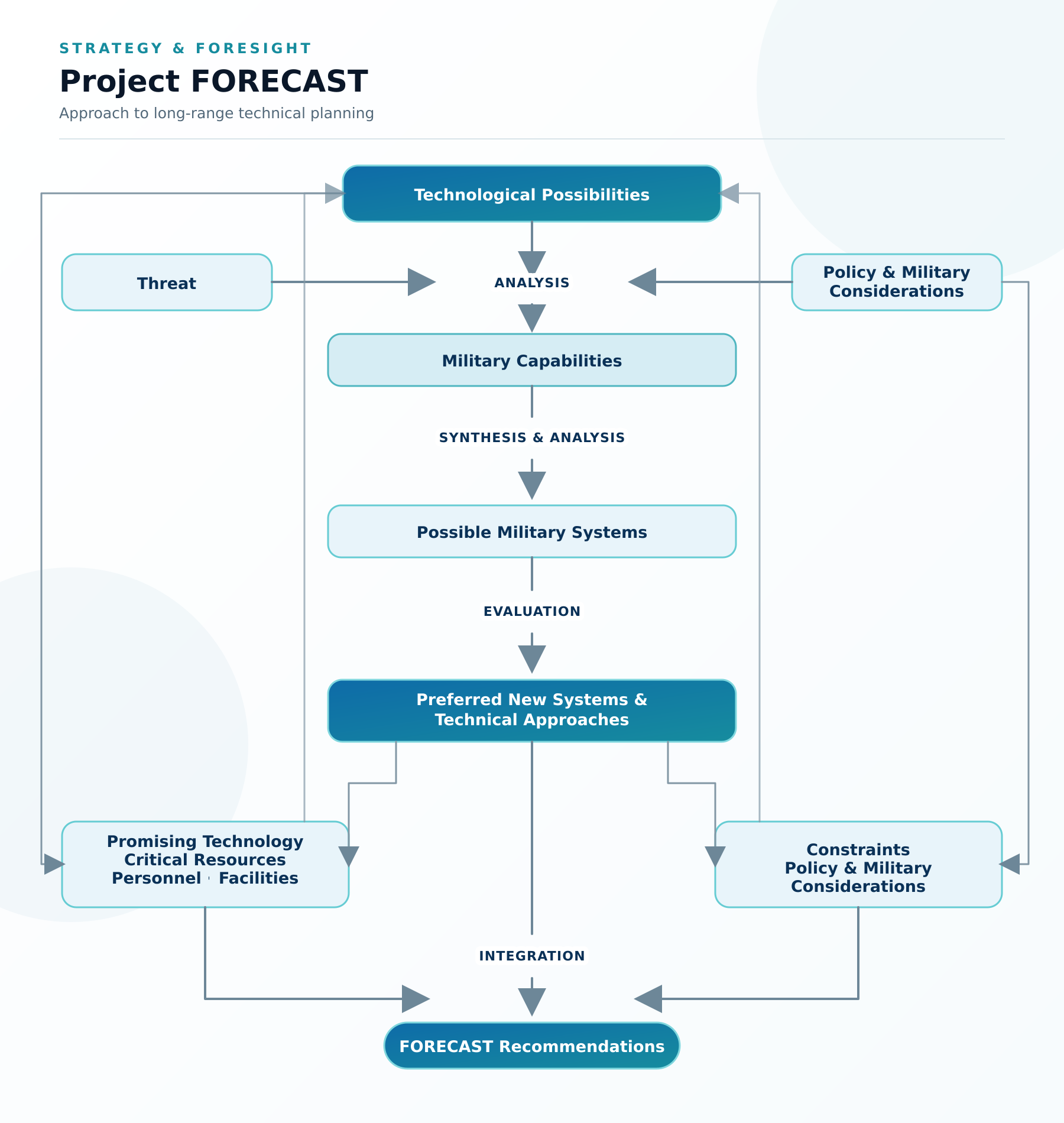
The organizational design reinforced the analytical design. Separate groups studied technology, policy, threats and mission capabilities before an analysis, evaluation and synthesis function brought their work together. The process made disagreement and different forms of expertise productive rather than inconvenient.
The corporate equivalent would combine technological foresight, customer and market change, competitor trajectories, regulation, economics and the organization’s governing intent. None is strategy by itself. Their intersection defines the strategic problem.
Capabilities before solutions
The most reusable feature of Project FORECAST is the separation of capabilities from systems. Its participants did not begin by asking which aircraft, missile, or computer to build. Capability panels first considered what the Air Force would need to be able to do across general war, limited war, continental defense, intelligence and reconnaissance, command and control, logistics and space. Only then did the project formulate possible systems.
This reverses a common pattern in corporate planning. Organizations frequently begin with a solution already embedded in the question: Which product should we launch? Which technology should we buy? Which market should we enter? The result is often a plan built around familiar assets, fashionable technologies, or an executive’s preferred initiative.
A capability-first strategy asks a different set of questions. What must customers be able to accomplish? What must the institution become unusually good at doing? Which abilities will remain valuable across more than one future? What must be true operationally before a particular strategic position is credible?
The answer may ultimately be a product. It may instead be a partnership, acquisition, distribution relationship, data asset, operational model redesign or new organizational competence. Defining the capability before selecting the system preserves a wider solution space.
Imagine broadly, then evaluate rigorously
After identifying required capabilities, Project FORECAST sought to postulate every conceivable system that might provide them. Schriever was explicit that most candidates would not reach final consideration. The purpose was to avoid overlooking possibilities before evaluation began.
Only after generating that broad option set did the project reduce the “shopping list.” Cost, effectiveness, policy alignment, feasibility and risk were applied as selection criteria. Proposals found deficient were not always discarded immediately; they could be sent back through the system for reconsideration and redesign.
This separation of divergence from convergence is easy to underestimate. Many strategic planning processes evaluate ideas at the moment they are proposed. Practical objections arrive before alternatives have had a chance to develop, leaving leaders to choose among slight variations of what the organization already knows how to do. Project FORECAST protected imagination temporarily, then demanded discipline.
Constraints should discipline strategic imagination, but they should not prevent it.
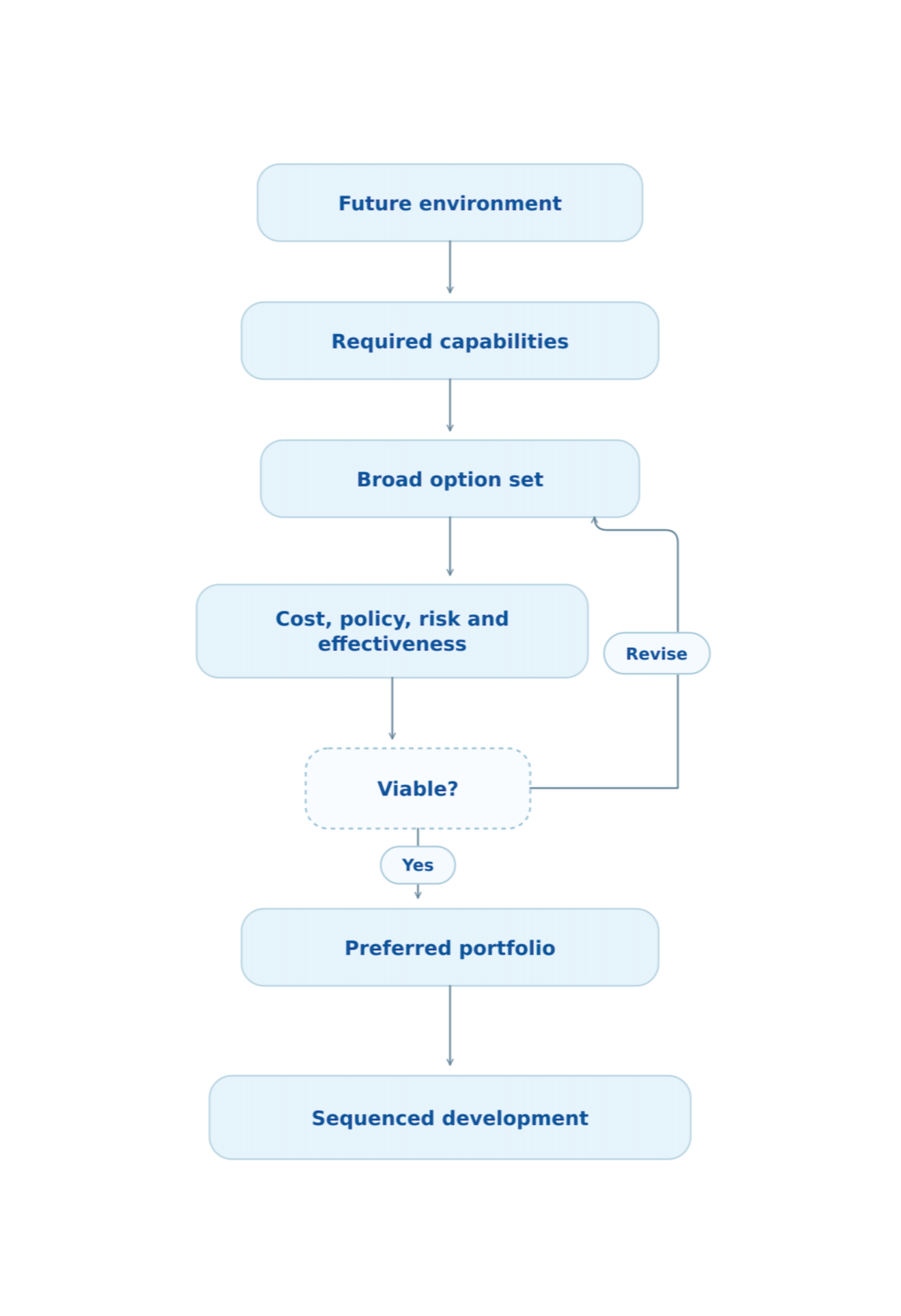
A contemporary interpretation of Project FORECAST’s iterative strategy logic. Adapted by Sender Consulting LLC from Schriever’s description.
Cornerstone capabilities and the value of options
Project FORECAST did not limit its attention to complete systems with immediate applications. It also identified “cornerstone areas”: enabling technologies that could support many future systems and accelerate a broader advance in capability. Schriever highlighted fields such as materials, propulsion, flight dynamics, navigation and guidance, and computing.
The contemporary analogue is a capability whose value is distributed across a portfolio of possible strategies. Proprietary data infrastructure, interoperability, digital identity, modular architecture, distribution access or an organization’s capability to run disciplined experiments may not belong to a single product business case. Their strategic value lies partly in the options they create.
This is a different investment logic from selecting only projects with the clearest near-term return. Under uncertainty, an enabling capability can be valuable because it improves several potential paths, makes future moves less costly, or allows the institution to delay an irreversible commitment until more information becomes available.
The key is not to label every shared investment “strategic.” A genuine cornerstone capability should expand the feasible option set, support multiple priority outcomes and be difficult to assemble after the need becomes obvious.
Options require concentration and maneuver
Creating options is not the same as avoiding commitment. Giulio Douhet’s most useful contribution here is his logic of the decisive field: technological change can create a domain or capability whose control gives an institution wider freedom of action. His prescription was concentration. In corporate terms, some capabilities create disproportionate advantage, and diffusing resources across familiar activities can prevent those capabilities from becoming real.
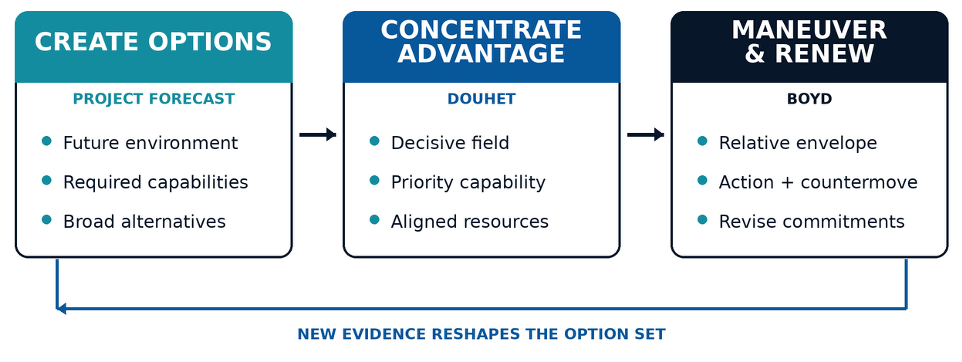
Sender Consulting LLC’s synthesis of Schriever, Douhet, and Boyd.
Douhet’s confidence that airpower would be decisive also exposes the danger in that logic. He treated a contingent advantage as nearly axiomatic, underestimating the effectiveness of air defenses, the resilience of civilian populations and industrial systems, and an adversary’s capacity to adapt. John Boyd’s Aerial Attack Study supplies a useful corrective. Boyd began with the actual capabilities and limitations of both sides, then demonstrated how a maneuvering opponent changes the attack envelope. Advantage, in other words, is relative to one’s own system, the opponent’s system and the conditions of the encounter.
Together, these perspectives add two disciplines to FORECAST’s creation of options. Leaders must concentrate enough resources to make an important option credible, then remain prepared to maneuver as evidence changes the competitive envelope. The aim is not to maximize the number of options indefinitely. It is to build a portfolio of credible options, recognize which could become strategically important and preserve the ability to redirect commitments before they harden into doctrine.
Strategy is a sequenced portfolio of commitments
Schriever also emphasized that Project FORECAST’s proposed systems were objectives for sequential rather than simultaneous development. Some possibilities were sufficiently mature for near-term action. Others required further study, technical progress or the prior development of enabling capabilities.
A serious strategy therefore needs more than a list of priorities. It must distinguish among commitments of different maturity and reversibility: what to deploy now, what to test, what to enable, what to preserve as an option, what to monitor and what to abandon. It should also specify the evidence or event that would justify increasing, redirecting or ending a commitment.
Cost analysis was continuous in FORECAST, not an exercise added after the strategy had been chosen. Personnel and facilities were also treated as integral. This forced the project to connect strategic ambition with the machinery required to produce a capability: capital, talent, infrastructure, time and institutional capacity.
That is an important corrective for corporate strategy. An initiative is not feasible merely because its market logic is attractive. The organization must be able to build, govern, absorb, and scale the capabilities on which it depends.
The constraint moves
Schriever observed that computers were transforming military operations but also creating new problems almost as rapidly as they solved old ones. As systems and programs grew, programming requirements, costs and lead times threatened to offset part of the technology’s benefit.
The strategic problem was no longer simply acquiring more computing power. It was changing the relationship between people and machines: making computers more accessible to nontechnical users, reducing programming burdens and redesigning supporting systems around the new capability.
The same reasoning applies to artificial intelligence. As model capability improves, the limiting factor may migrate to proprietary data, workflow integration, governance, human review, trust, liability or the organization’s ability to redesign work. Technology can remove one bottleneck while exposing another.
A sound technology strategy therefore asks not only what an innovation can do, but which new constraint is likely to become decisive once adoption begins and whether that shift changes the competitive envelope enough to alter the portfolio.
Strategy as future freedom of action
These sources operate at different levels and should not be treated as complete theories of institutional strategy. Project FORECAST was shaped by the technological and geopolitical priorities of the 1960s. Douhet correctly recognized that technological change could create a newly decisive domain, but he treated airpower’s decisiveness too deterministically, underestimating the effectiveness of air defenses, the resilience of civilian populations and industrial systems, and an adversary’s capability to adapt. Boyd’s Aerial Attack Study was narrower: it demonstrated how effective action must reflect the relative capabilities and limitations of one’s own system and an opponent’s system. Their value here lies not in adopting their conclusions wholesale, but in extracting complementary disciplines for planning under uncertainty.
But the architecture remains powerful because it does not require leaders to know one future with certainty. It links purpose to future capabilities; capabilities to alternative systems; alternatives to cost, risk and effectiveness; and preferred choices to the resources and sequence required for execution. It treats strategy as an iterative portfolio rather than a fixed destination.
Douhet and Boyd add two disciplines to that architecture. Douhet emphasizes the need to concentrate resources when an option becomes strategically decisive. Boyd shows why any such commitment must remain responsive to the relative capabilities of competitors and to changing conditions. Together, they clarify that preserving options is not an alternative to commitment: strategy requires leaders to create choices, concentrate selectively and revise their commitments as evidence changes.
For leaders today, the enduring question is not “What do we believe the future will be?” It is “What must we begin building now so that we retain meaningful choices as the future reveals itself?” It is also, “Which choices now warrant concentration, and what evidence would tell us to redirect our commitments?”
Strategic planning under uncertainty is the deliberate creation of future options, selective concentration behind the most credible options and continuous adaptation to preserve freedom of action as conditions change.

Enjoyed this analysis?
Sources
Bernard A. Schriever, “Forecast,” Air University Review 16, no. 3 (March-April 1965), 2-12
Giulio Douhet, “The Command of the Air,” trans. Dino Ferrari. (Air University Press, 2019), pp. 5, 45-47, 188-89 and 223-42
John R. Boyd, “Aerial Attack Study,” 50-10-6C, rev. 11 August 1964, pp. 1, 41-49 and 146