

The Token is Live. Is the Market?
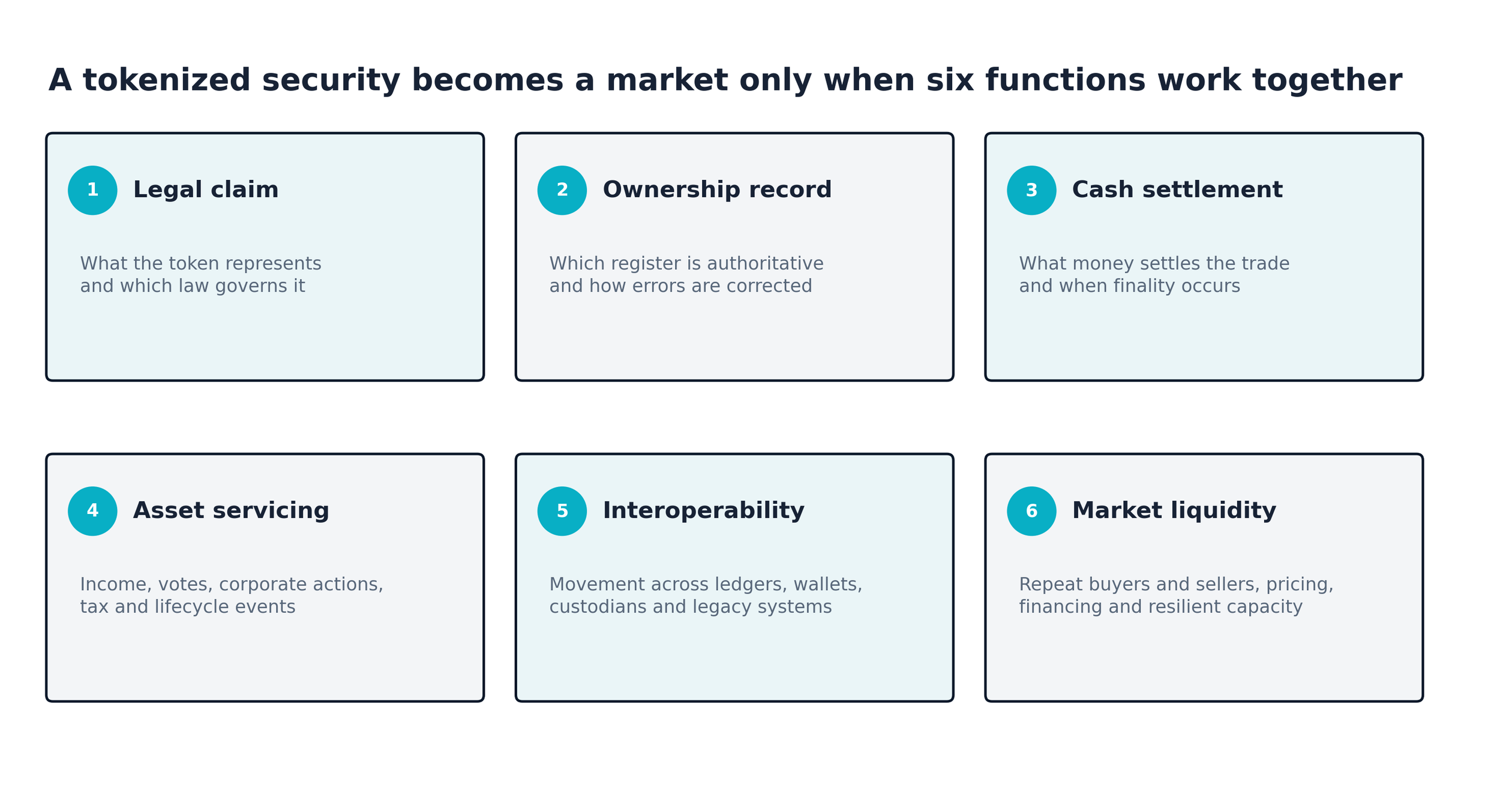
The token is live. The market is still being assembled. Public evidence now demonstrates real production transactions, regulated tokenized representations of securities, atomic settlement prototypes and central bank money bridges approaching operation. It does not yet demonstrate that most tokenized assets trade continuously, move freely across venues, receive complete lifecycle servicing or attract durable two-sided liquidity.
The analytical mistake is to treat issuance, settlement and liquidity as one event. They are separate control points. A tokenized instrument can be legally valid and settle successfully while remaining dependent on a designated custodian, a closed participant set, a manual runbook or a conventional register. Those dependencies may be sensible. They simply define the market that actually exists.
The milestone moved
For years, the central question was whether regulated institutions could issue or transact with tokenized assets at all. That threshold has now been crossed.
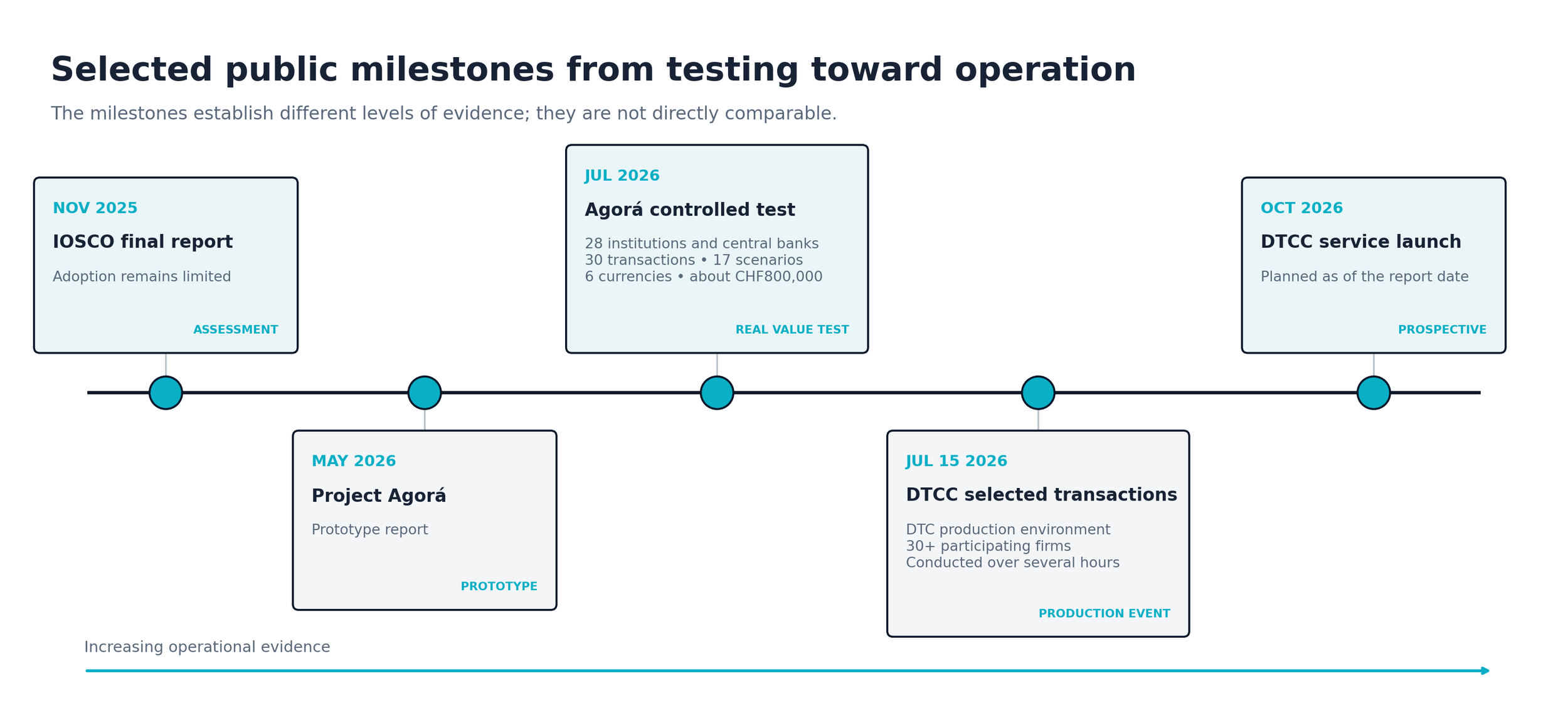
On July 15, 2026, DTCC reported that it converted assets held at The Depository Trust Company into tokens and used them in what it described as real production trades. More than 30 firms participated. The selected workflows included collateral pledging, securities lending, a U.S. Treasury/repo delivery-versus-payment transaction, equity delivery-versus-payment and delivery-versus-delivery transactions, an equity token transfer and central counterparty margin activity. The transactions were conducted over several hours in a DTC production environment, ahead of the DTCC Tokenization Service’s planned October 2026 launch. The underlying securities remained DTC-held assets that could be converted between traditional and tokenized form.
Project Agorá has advanced a different part of the operating stack. The Bank for International Settlements developed a prototype that combines tokenized central bank reserves and tokenized commercial bank deposits on a shared programmable platform. During controlled real value testing in July 2026, 28 financial institutions and central banks completed 30 transactions across 17 scenarios and six currencies, representing approximately CHF800,000 in aggregate value. The exercise demonstrated the feasibility of atomic settlement for the tested wholesale cross-border payment scenarios. It also relied on predefined transaction windows, a detailed operational runbook, contractual arrangements, an operational facilitator, fallback procedures and several manual approval points.
Both initiatives represent genuine advances beyond conceptual demonstrations. Neither, however, establishes by itself that a continuously operating tokenized market exists. DTCC demonstrated selected transactions in a production environment, but its broader service launch remained prospective as of the report date. Project Agorá processed real monetary value under realistic conditions, but the BIS continues to characterize it as a prototype rather than a finished product. The evidence establishes operational feasibility under defined conditions—not continuous access, sustained liquidity or fully commercial operation.
One word conceals several legal and operational models
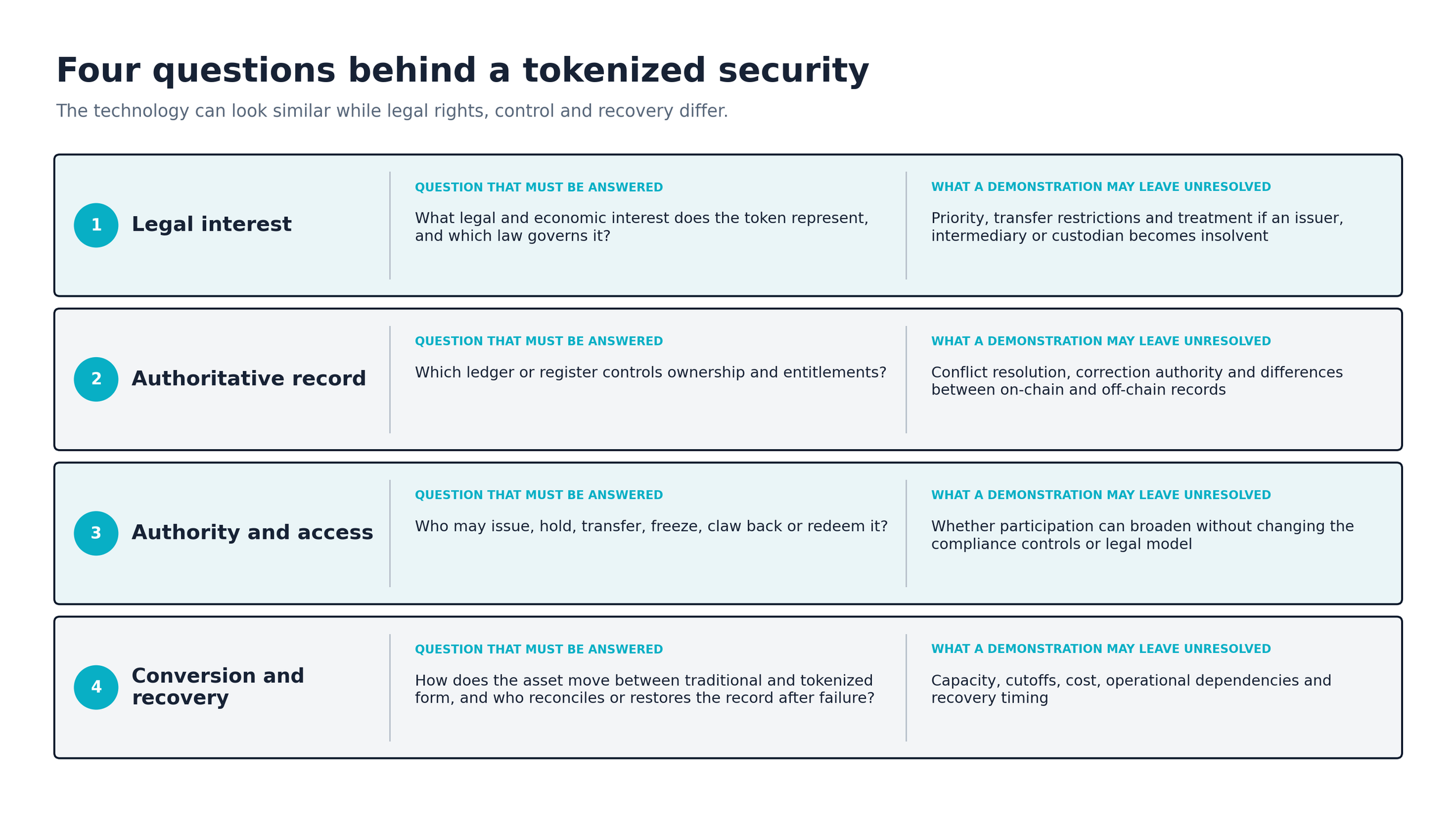
“Tokenization” can describe materially different legal and operational structures. Depending on the governing law and transaction documents, a token or its associated ledger entry may constitute or evidence the security itself; represent a conventionally issued security recorded in another authoritative register; operate as an on-chain record synchronized with an off-chain register; or represent a contractual or beneficial interest in an asset held by an intermediary or special-purpose vehicle. Similar technology can therefore produce materially different ownership rights, transfer mechanics and insolvency outcomes.
DTCC’s model illustrates the distinction. Its Tokenization Service creates tokenized representations, also described as digital twins, of securities held at DTC. DTCC states that these assets can move between traditional and tokenized form using the same CUSIP and are designed to carry the same legal rights, economic interests and investor protections as the underlying securities. The service also incorporates compliance and operational controls, including mint, burn, pause and clawback functionality, and supports ownership tracking across traditional and blockchain records.
That architecture can extend established custody, settlement and asset-servicing processes into tokenized workflows. It does not mean that DTC’s role or the conventional market infrastructure perimeter has disappeared. Nor does it mean that the token can circulate without the service’s eligibility rules, approved networks, wallet arrangements, compliance controls and reconciliation processes.
The first diligence question is therefore not which blockchain was used. It is what legal interest the token represents; which record controls ownership and entitlements; who may issue, hold, transfer, freeze or redeem it; how conflicting records and operational errors are corrected; and how the investor’s claim would be treated if an issuer, intermediary, custodian or technology provider failed.
A security needs a cash leg
A tokenized asset transaction is not complete merely because the security moves on a distributed ledger. The buyer’s settlement asset and the seller’s security must both transfer with legally and operationally reliable finality. If the asset moves on one system while payment settles later or through another system, the parties can retain principal, counterparty, funding and reconciliation risk. Atomic delivery-versus-payment can reduce principal risk by making the asset and payment transfers conditional on one another. It does not, by itself, eliminate liquidity, operational, legal or technology risk.
The harder question is what provides the settlement asset. A transaction may settle using central bank reserves, tokenized commercial bank deposits, a regulated stablecoin or another cash instrument. These are not interchangeable. Each involves a different issuer, credit exposure, redemption mechanism, operating window, legal characterization and connection to the conventional banking system.
Project Agorá’s significance is therefore not merely that it used tokens. Its prototype combined tokenized central-bank reserves with tokenized commercial bank deposits and tested atomic settlement across currencies and jurisdictions. The BIS states that tokenization did not alter the underlying legal character of the reserves or deposits. The July 2026 real-value exercise demonstrated feasibility under controlled conditions; it did not establish a continuously operating multicurrency settlement system.
Europe is pursuing a bridge model. The Eurosystem’s Pontes initiative is intended to connect market distributed-ledger platforms with TARGET Services, allowing eligible tokenized wholesale transactions to settle in central-bank money. As of the ECB’s July 22, 2026 update, Eurosystem testing was underway and participant testing was scheduled to begin in August. Pontes is the nearer-term connection to existing TARGET infrastructure; Appia is the longer-term initiative intended to shape a more integrated European tokenized finance ecosystem. The distinction matters: a bridge to central bank money can strengthen the cash leg without proving that the underlying tokenized assets have broad distribution or secondary market liquidity.
Settlement does not create liquidity
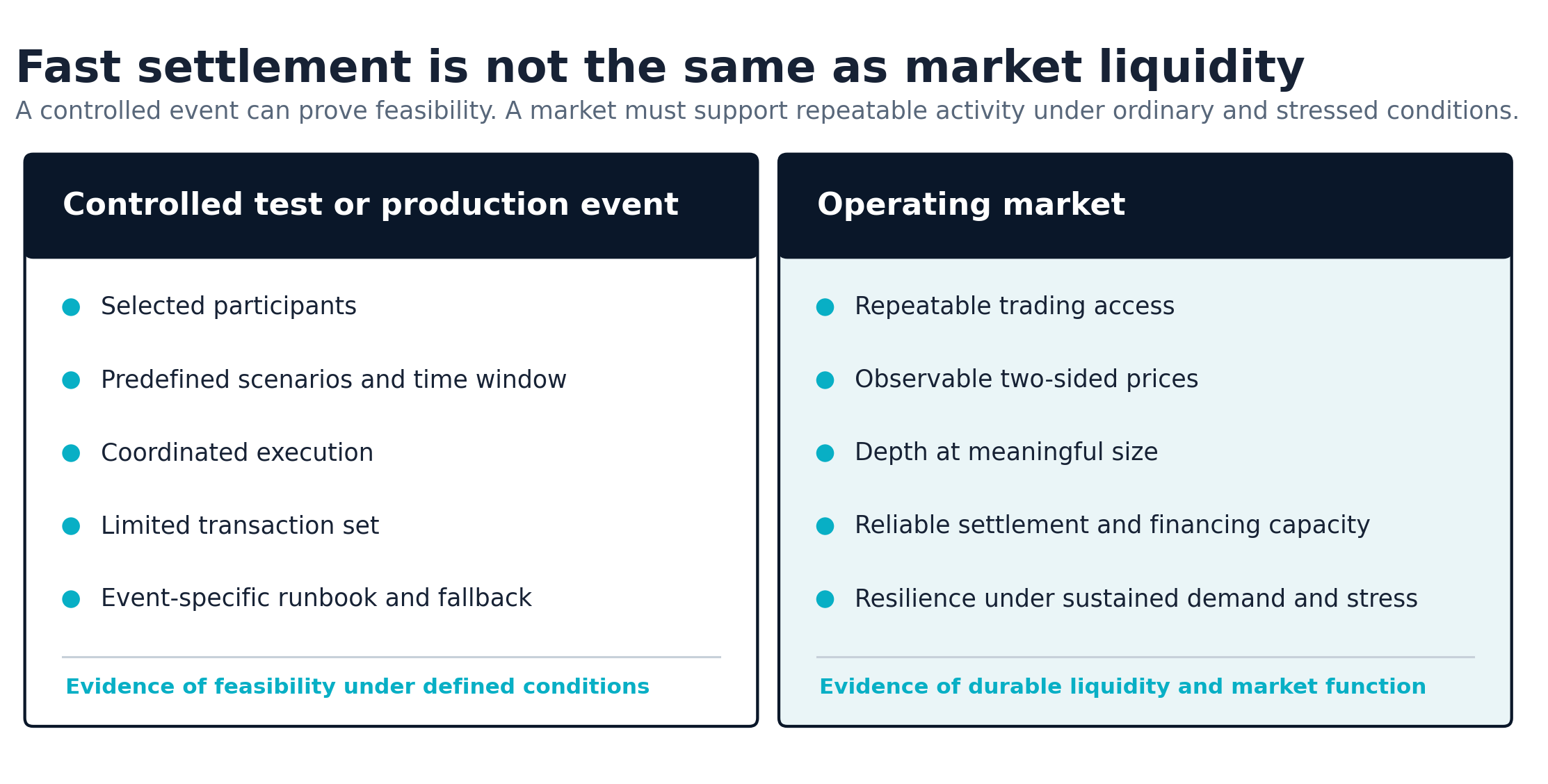
A market requires more than a technically valid transfer. It needs repeat buyers and sellers, credible price discovery, inventory or financing capacity, reliable access to settlement assets and operating rules that remain usable beyond a scheduled transaction window. A transaction can settle in seconds while the asset remains difficult—or costly—to sell tomorrow.
Settlement efficiency and market liquidity are separate attributes. Atomic delivery-versus-payment can reduce principal risk and shorten a transaction’s settlement process. It does not create a two-sided market, guarantee executable prices or ensure that dealers and financing providers will commit balance-sheet capacity under stress.
This is where public claims can run ahead of the evidence. A controlled test can measure transaction time, demonstrate atomicity and verify that selected systems communicate correctly. It does not, by itself, establish the bid-ask spread, trading depth, price impact, turnover, financing availability or resilience that would prevail under sustained market demand. Those conclusions require recurring activity under ordinary and stressed conditions—not merely the successful completion of selected transactions.
IOSCO’s 2025 report found that adoption of tokenized financial assets remained limited and that reported efficiency gains were uneven and generally not supported by publicly disclosed quantitative evidence. It also identified risks involving unclear ownership structures, third-party token issuers, technology and operations, and potential spillovers from greater interconnection with cryptoasset markets. IOSCO’s findings support a narrower conclusion: tokenization may improve particular transaction processes, but faster settlement should not be treated as evidence of secondary-market liquidity.
Asset servicing is where the instrument becomes durable
Issuance receives attention because it is visible. Lifecycle servicing determines whether a tokenized instrument can operate reliably after issuance. Depending on the asset and legal structure, that may include interest, dividends, principal payments, voting, corporate actions, tax withholding, restructurings, collateral substitutions, transfer restrictions, freezes, corrections, and procedures for compromised or inaccessible credentials.
Tokenization can automate portions of these workflows, including conditional payments and corporate actions. But automation depends on authoritative data, legally effective instructions, reliable external inputs, defined control rights, and procedures for exceptions. A smart contract executes the rules and data made available to it; it cannot independently resolve whether a payment is legally due, interpret an ambiguous court order, correct faulty source data, or determine which record prevails after systems diverge.
Durable tokenized markets therefore require both programmable execution and governed intervention: clearly identified authorities must be able to approve exceptions, correct records, manage disputes, and reconcile the tokenized system with legally authoritative books and records.
Interoperability is not the number of networks
A multi-network strategy can reduce concentration in a single technology and allow participants to use different platforms. It can also multiply bridges, identities, technical standards, reconciliation points, governance arrangements, and third-party dependencies. More connected networks do not necessarily produce greater operational resilience.
Meaningful interoperability is the ability to transfer or use an asset across systems while preserving—or reliably reestablishing—its legal rights, ownership record, controls, and servicing information. Depending on the architecture, movement may require conversion, burning and reissuance, an update to an authoritative off-chain register, or reconciliation by a custodian or other regulated intermediary. The objective is to avoid revalidating and manually reconstructing the asset at every boundary, even when some controlled reconciliation remains necessary.
The relevant tests are practical: Can the asset move or be used across ledgers without ambiguity about ownership and encumbrances? Can a custodian or registrar reconcile it to the authoritative record? Can cash settle against it with legal and operational finality? Can required compliance and lifecycle information—including transfer restrictions, tax attributes, and corporate-action entitlements—remain associated with the position? Can ownership and access be restored if a wallet, network, bridge, or service provider fails?
The market needs a better evidence hierarchy
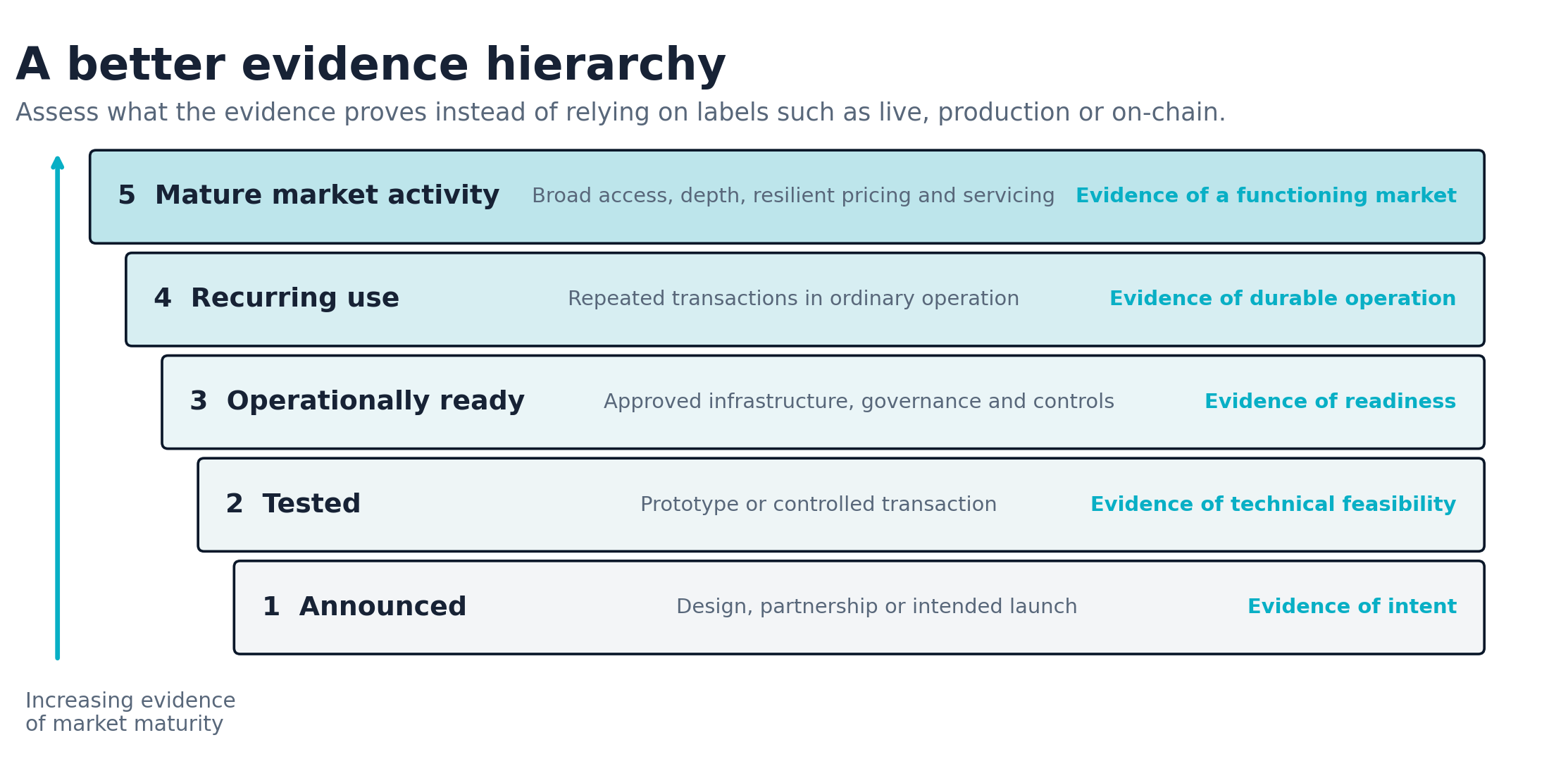
The vocabulary of “live,” “production,” and “on-chain” is not standardized. Those labels should be tested against an evidence hierarchy that distinguishes announcement, technical feasibility, operational readiness, recurring use, and mature market activity. Each stage establishes something different: a prototype demonstrates feasibility; controlled real-value transactions demonstrate limited operation; and recurring activity under ordinary conditions provides stronger evidence of durable use.
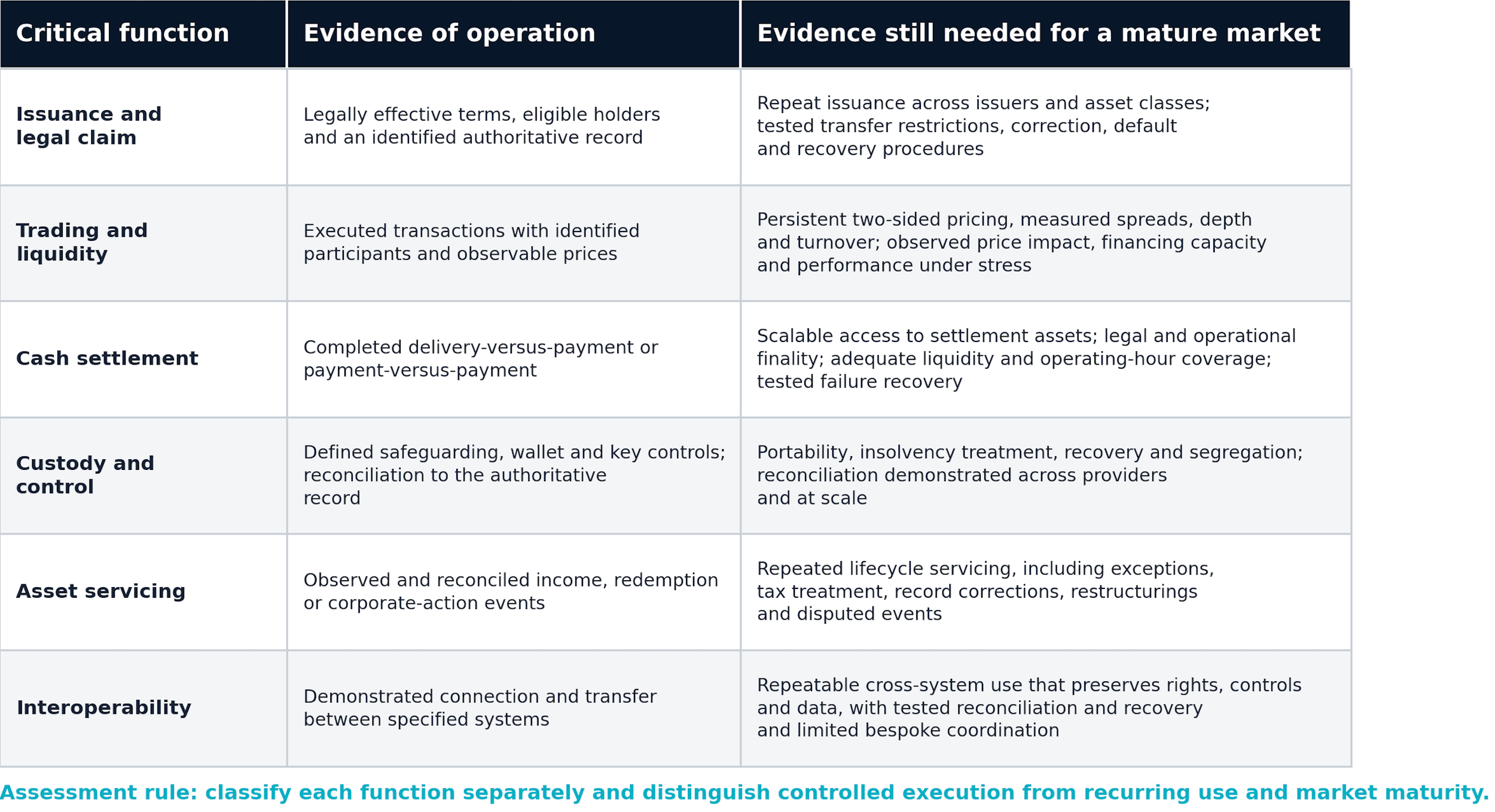
A program can legitimately occupy different stages for different functions. Legally effective issuance, tested settlement, partly manual asset servicing, restricted participation, and thin secondary liquidity can coexist within the same product. The maturity of the instrument or platform should therefore be assessed function by function rather than inferred from a single “live” or “production” designation.
Count functions, not announcements
A defensible market assessment should ask whether each critical market function operates repeatedly under ordinary conditions—and whether it remains reliable during exceptions and periods of stress. The following scorecard prevents a single issuance, pilot, or settlement milestone from being treated as evidence that the entire market is operational.
The market may be an integrated bridge, not a clean replacement
The emerging architecture does not necessarily eliminate existing market infrastructure. DTCC’s model creates tokenized representations of securities held at DTC and permits conversion between conventional and tokenized forms. Pontes is designed to connect market distributed ledger platforms with TARGET Services so the cash leg can settle in central bank money. Project Agorá combines tokenized central bank reserves and commercial bank deposits on a shared programmable platform while preserving their underlying legal and balance sheet characteristics.
These models differ. DTCC and Pontes explicitly connect tokenized activity with established depository or payment infrastructure. Agorá tests a potentially new shared platform architecture, but its real value transactions still interacted with RTGS and core banking systems through established messaging and operational processes; the prototype was not fully integrated with those systems. None is a blank sheet removal of the existing financial system.
That may be the pragmatic path to scale. Depositories, payment systems, custodians, banks, and regulated intermediaries already provide established legal frameworks, controls, liquidity arrangements, and operating reach. Tokenization may eliminate or reduce some messaging, reconciliation, and settlement steps while retaining—or creating—others at the boundaries between systems.
The relevant measure is therefore not how much legacy infrastructure disappears. It is whether the combined architecture produces demonstrable reductions in cost, delay, reconciliation, liquidity usage, and operational risk after its connectivity, governance, fallback, and exception-management requirements are included.
The token is live. The market is being assembled.
The public evidence is now strong enough to reject the claim that financial-asset tokenization is exclusively experimental. Legally recognized securities and monetary claims have been represented on programmable platforms, and real value transactions have occurred in production and controlled testing environments. Regulated institutions are building issuance, settlement, custody, interoperability, and governance arrangements around those transactions.
The evidence is not yet strong enough to treat a successful tokenized transaction as proof of a mature tokenized market. Legally effective issuance, authoritative ownership records, cash finality, safeguarding, lifecycle servicing, interoperability, and liquidity must work repeatedly under ordinary conditions and remain reliable when a participant fails, a network pauses, a corporate action is disputed, or trading demand increases sharply.
The next phase will be less theatrical and more revealing. The decisive evidence will include recurring volume, observable pricing and market depth, measured costs, completed lifecycle events, broader participation, reliable access to settlement assets, and resilience without event-specific coordination. The token is live. The market will be functioning when activity can recur without depending on a demonstration—and when the surrounding legal and operating system continues to work through exceptions and stress.

Enjoyed this analysis?
Research boundaries
Evidence window. Sources were published or current between November 2025 and September 2026. Events or launches scheduled after the report date are identified as prospective. Earlier facts appear only when cited by sources within the evidence window.
Different token models. Native digital securities, digital twins, tokenized fund interests, tokenized deposits, central bank money, and stablecoins are not legally, economically, or operationally interchangeable. The rights attached to a token depend on its governing documents, authoritative record, issuer, custody structure, and applicable law.
Evidence is function-specific. A project may demonstrate legally effective issuance or completed settlement without demonstrating mature custody, asset servicing, interoperability, or secondary-market liquidity. Labels such as “live,” “production,” and “on-chain” do not establish a uniform level of maturity.
Tests are not markets. Participant count, transaction count, and value in a controlled exercise establish the scope of testing. They do not, by themselves, establish sustained adoption, commercial viability, market depth, price discovery, financing capacity, or resilience under stress.
Technical completion is not necessarily legal finality. Ledger confirmation, transaction irreversibility, and atomic execution do not automatically establish when an underlying legal obligation is discharged. Finality depends on the instrument, settlement asset, system rules, and applicable law.
Public market data remain incomplete. Public disclosures do not consistently provide comparable measures of recurring volume, transaction costs, bid-ask spreads, market depth, failure rates, manual intervention, or lifecycle-servicing performance.
Source descriptions. Project operators’ disclosures establish what those organizations reported and how they characterized their systems. Unless otherwise stated, they are not independent audits of performance, scalability, cost savings, or every claimed benefit.
No investment or legal advice. The report analyzes market infrastructure and publicly available evidence. It does not assess the suitability, value, tax treatment, or legal status of any particular tokenized instrument for a specific investor or jurisdiction.